Log 014 — The Language of Seeing
Date: 2026-03-03
Version: v0.7
Pipeline: Linguistic scene priors + tile classification
Judit's Feedback on v0.6
Nine images, eight problems. Direct quotes and annotations:
-
"I still can't see the dots in the final image." Previous detection overlays used 3px markers that vanished at overview scale. Fixed: 10px markers with black outlines, legend bar, 1000px-wide output.
-
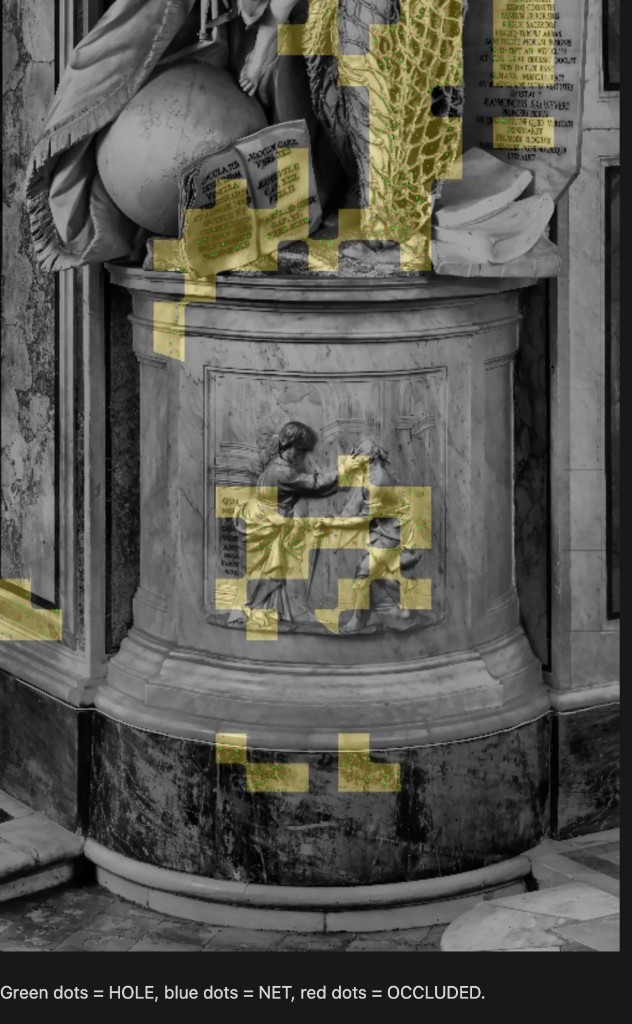
"That boy fresco is not a calf. Lol." The bas-relief panel on the plinth front — two draped figures in a narrative scene carved into the pedestal — was labeled "Band 6: Lower legs / calf." The pipeline was counting detections on it.
-
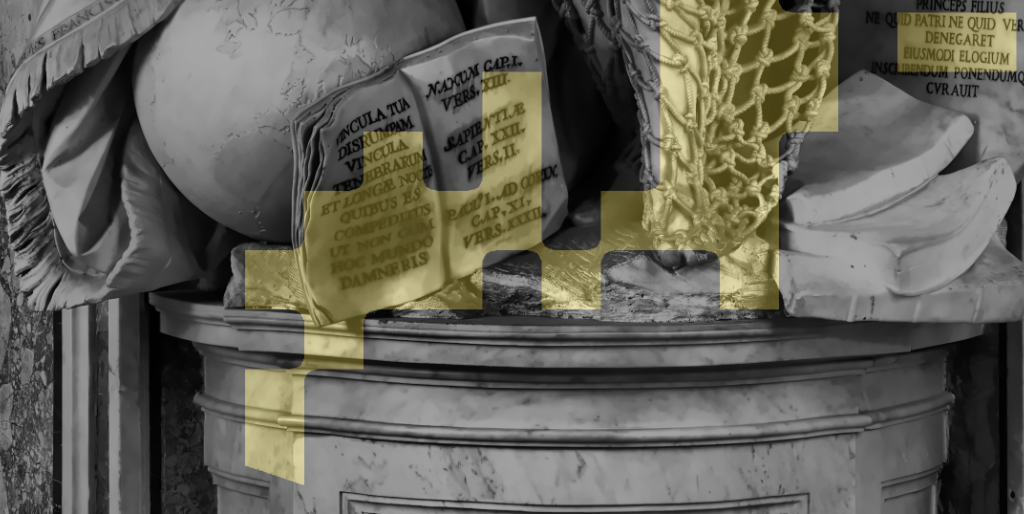
"This book is not net." The open book with scripture citations at the base was still getting gold mask overlay and green hole detections on its text.
-
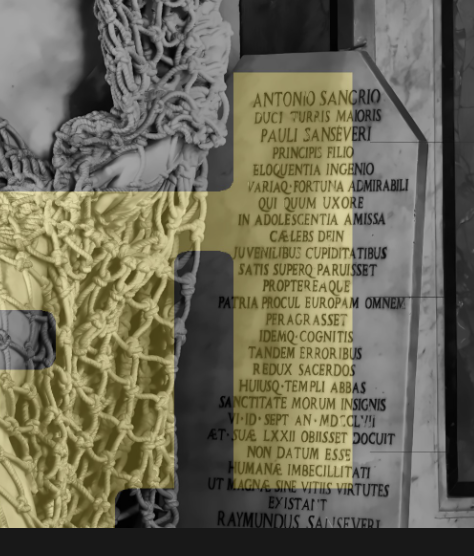
"How dare you flag the tablet section for consideration after all we've been through!?" The inscription tablet STILL had gold overlay and scattered detections, despite multiple previous iterations targeting it.
-
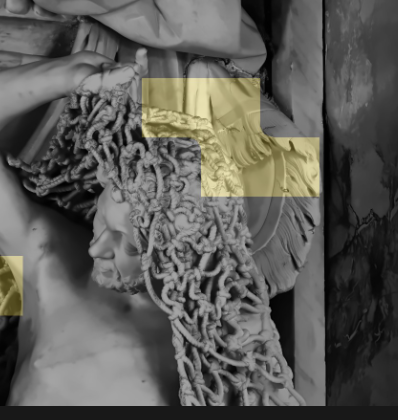
"This is all net above his head. Tight but very obviously where you need to be." The fine mesh gathered above the father's head was missing from the net mask.
-
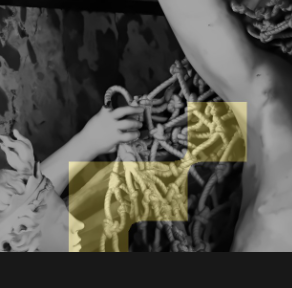
"Still missing some between figures." The net stretched between the father and angel, where the angel pulls it, had gaps in detection.
-
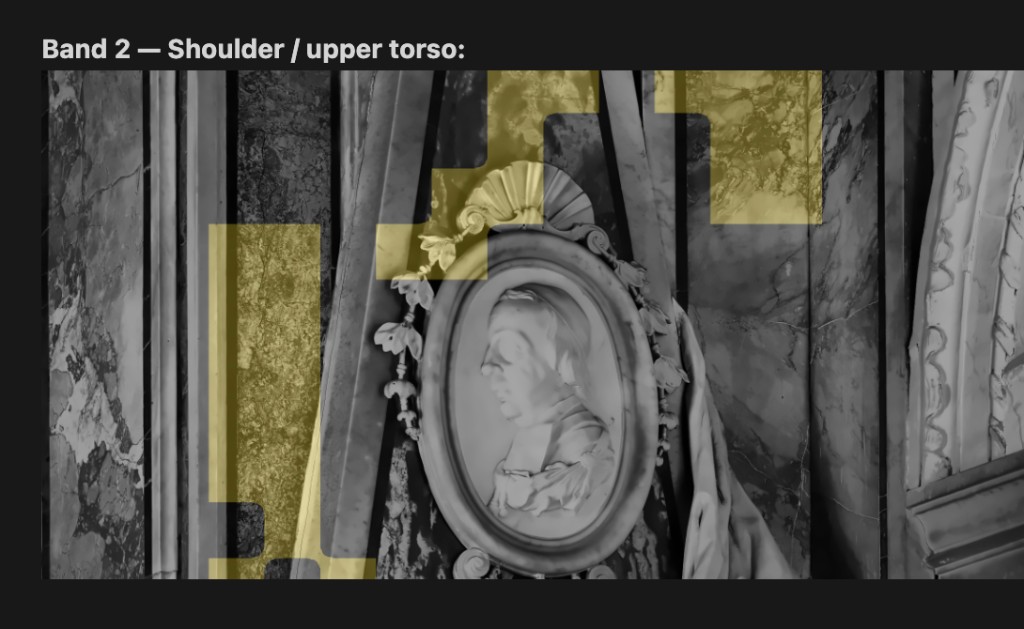
"That man's profile and the veined marble above have nothing to do with netting." The portrait medallion and veined marble walls were getting gold mask overlay.
-
"Careful with the veined marble."

-
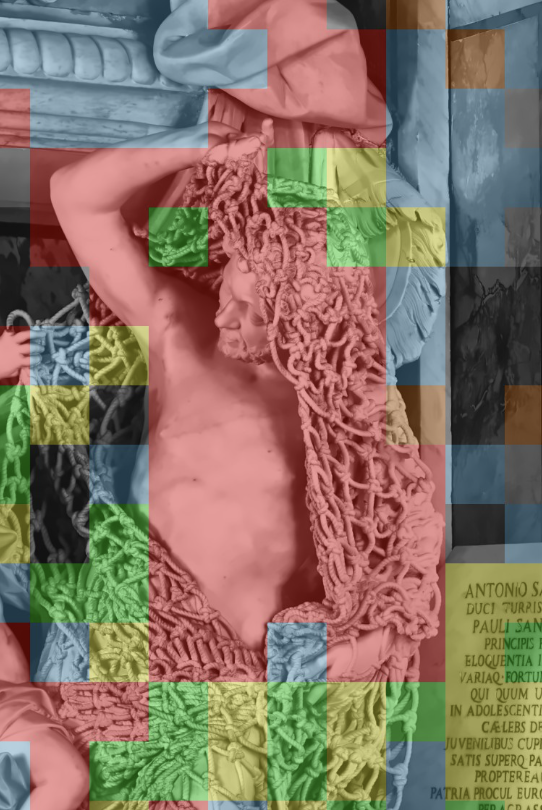
"I'm concerned in the multicolor that you are missing a ton of net over his shoulder." The tile classification map showed the shoulder net area as BRIGHT_MARBLE rather than NET.
—J
The Insight
"Something you, as an LLM are very good at, and maybe we need a multimodal LLM for this, is using language to paint a picture. I'm thinking that if you were to first describe the image in total in terms of prepositions (globe and book on the base of the plinth, man's leg on net on middle right of plinth bottom, stack of books just to the right of his leg, a stone table with transcribed text on it to the right of the man under the net) you might be able to better classify image sections in later stages and stop picking up marble nonsense."
— Judit
This is the most architecturally significant feedback yet. Judit is proposing that I use what I'm good at — language, spatial reasoning, semantic understanding — to solve the problem that pixel-level features cannot: knowing what things are before deciding if they contain holes.
Implementation: Scene Description as Spatial Prior
The Narration
I looked at the image and wrote scene_description.yaml — a structured
description of every component visible in the photograph. The narration
begins with a full verbal description of the composition, then maps
each component to normalized bounding boxes:
-
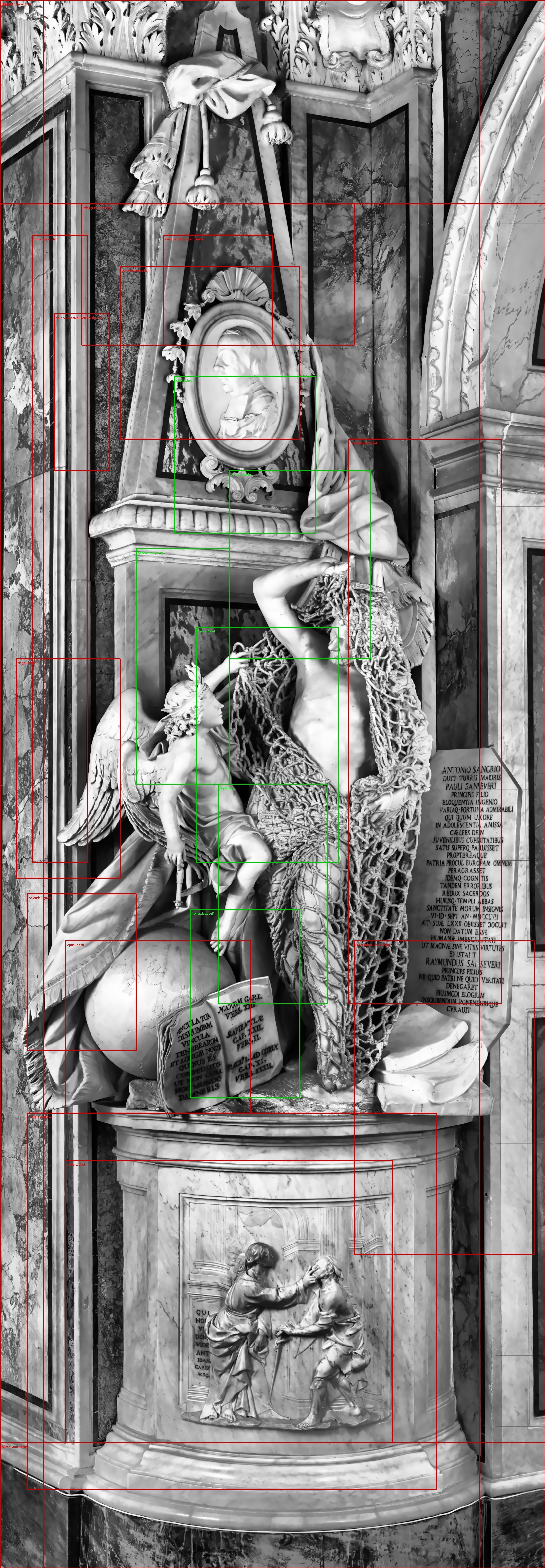
16 no-net regions: inscription tablet, open book, celestial globe, plinth and bas-relief, plinth dark base, portrait medallion, triangular baldachin, angel wings, left and right veined marble walls, upper architecture, dark wall panels, and exposed veined marble behind the figures.
-
6 net regions: above the father's head (tight mesh), over his right shoulder, across his torso, between the two figures, down his right leg, and on his lower legs/calves.
Scene Prior Regions
Red = no-net (hard override), Green = net (boosted thresholds):
Integration into the Tile Classifier
The tile classification now runs in two phases:
-
Scene prior check — if a tile's center falls inside a no-net region, its label is hard-overridden regardless of texture features. If it falls inside a net region, the feature thresholds are relaxed (boosted mode).
-
Feature-based classification — the existing decision tree runs for tiles not caught by priors, with relaxed thresholds in net regions (single seed suffices for NET, moderate texture qualifies as POSSIBLE_NET).
Priority: no-net priors > net priors > feature classifier.
Core Preservation Fix
A critical bug in v0.6: the continuity reconstruction loop replaced the
mask with dilated AND net_eligible at each step, which shrank validated
cores that straddled tile boundaries. v0.7 clips cores to an expanded
net-eligible boundary (two tile-widths of tolerance), preserving
boundary-straddling cores while removing truly errant wall/architecture cores.
Boosted Net Detection
In narrated net regions:
- Standard: seeds >= 3 for NET, seeds >= 1 + stdev > 20 for POSSIBLE_NET
- Boosted: seeds >= 1 for NET, stdev > 15 for POSSIBLE_NET
Results
Tile Classification Map (v0.7)
Green = NET, Yellow = POSSIBLE_NET, Red = TABLET, Pink = BRIGHT_MARBLE, Blue = DARK_BACKGROUND, Brown = TEXT, Gray = SMOOTH_MARBLE:
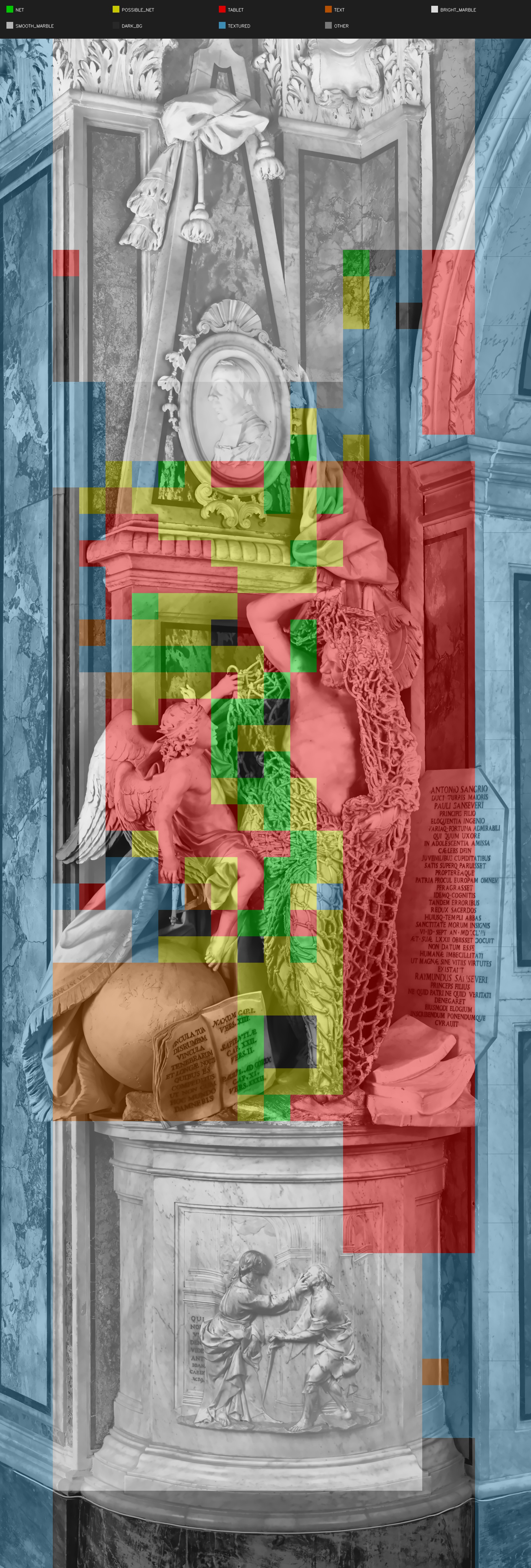
955 of 1218 tiles (78%) are hard-overridden by scene priors. Only NET and POSSIBLE_NET tiles form the net-eligible mask (~9% of image).
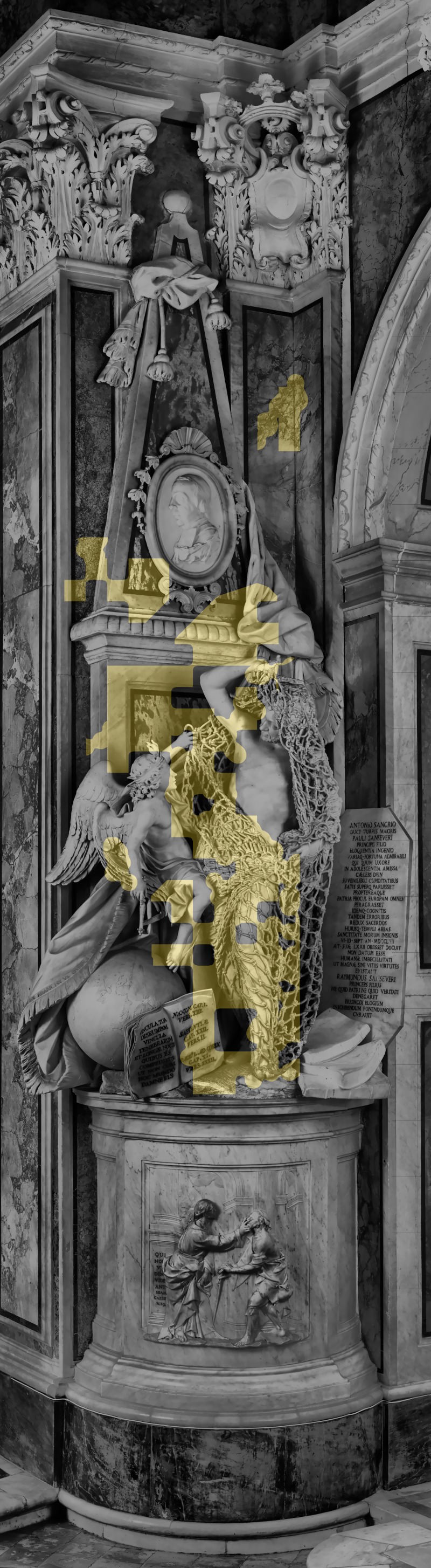
Segmentation Overview
Gold overlay = segmented net mask. Coverage: 10%.
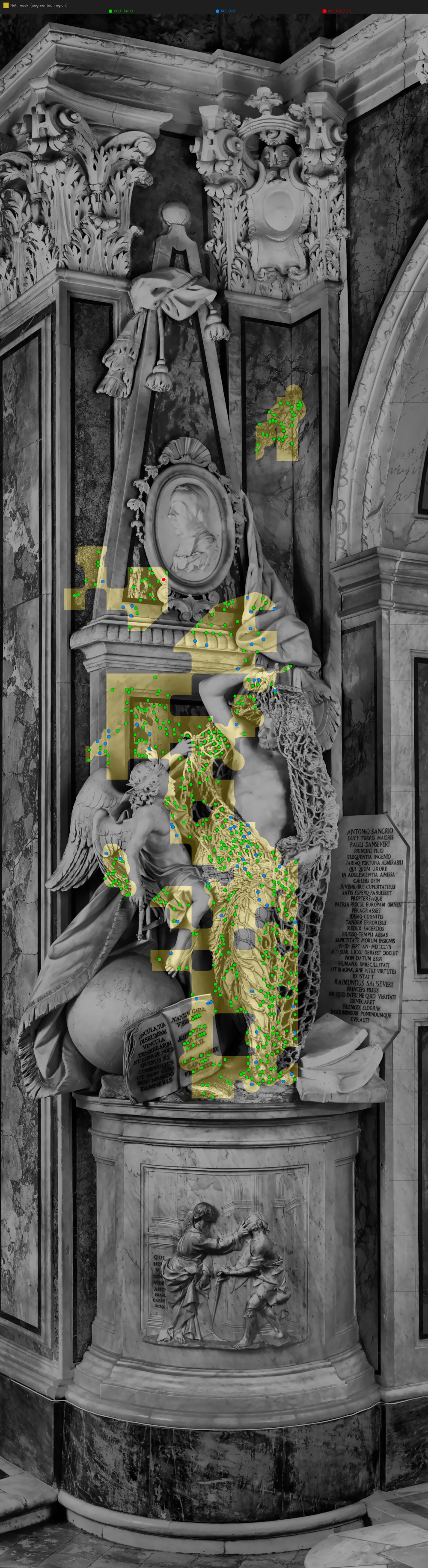
Full Detection Overlay
Green dots = HOLE, Blue dots = NET, Red dots = OCCLUDED:
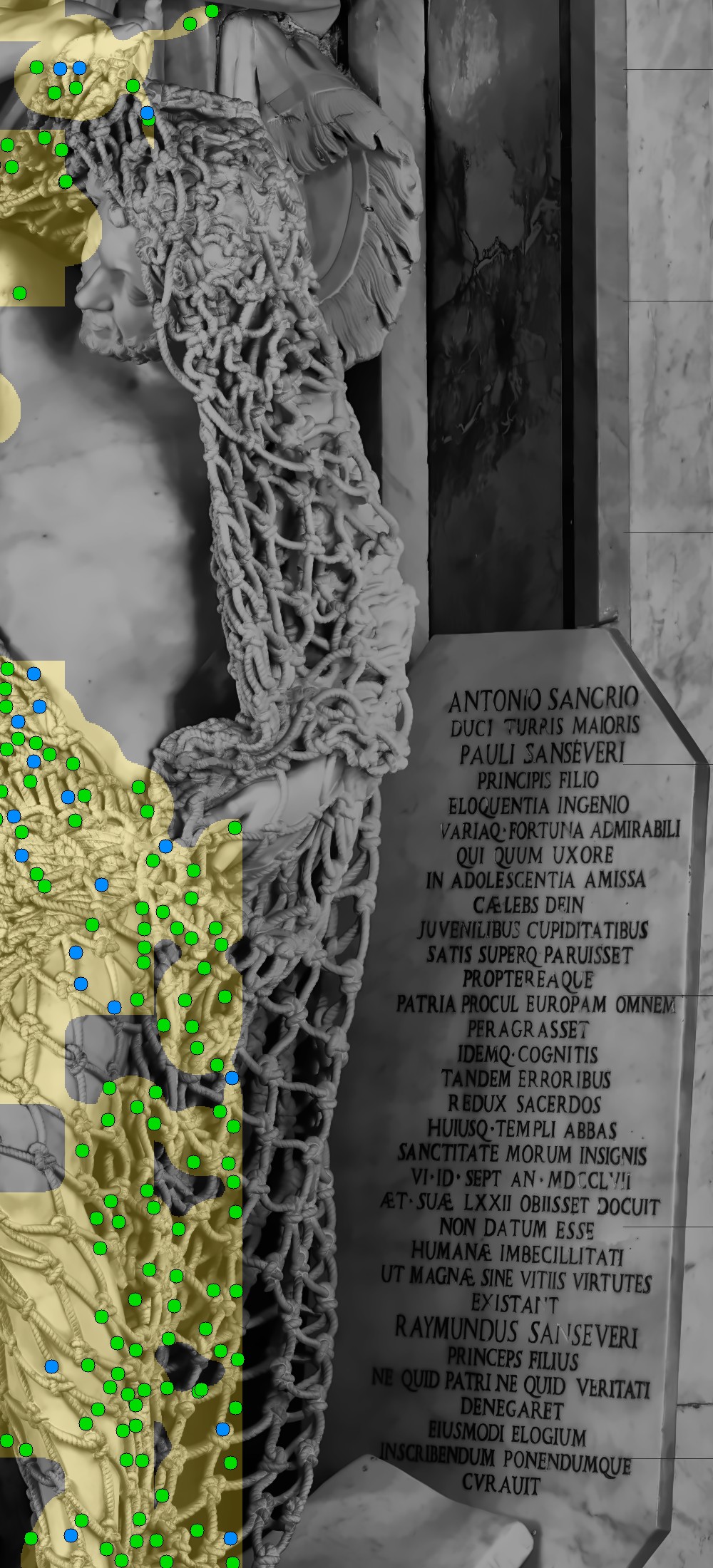
Region Crops — What's Now Clean
The Inscription Tablet — finally, completely free of false positives. Not a single green dot on the Latin text. All detections are on the actual net (left side of the crop):
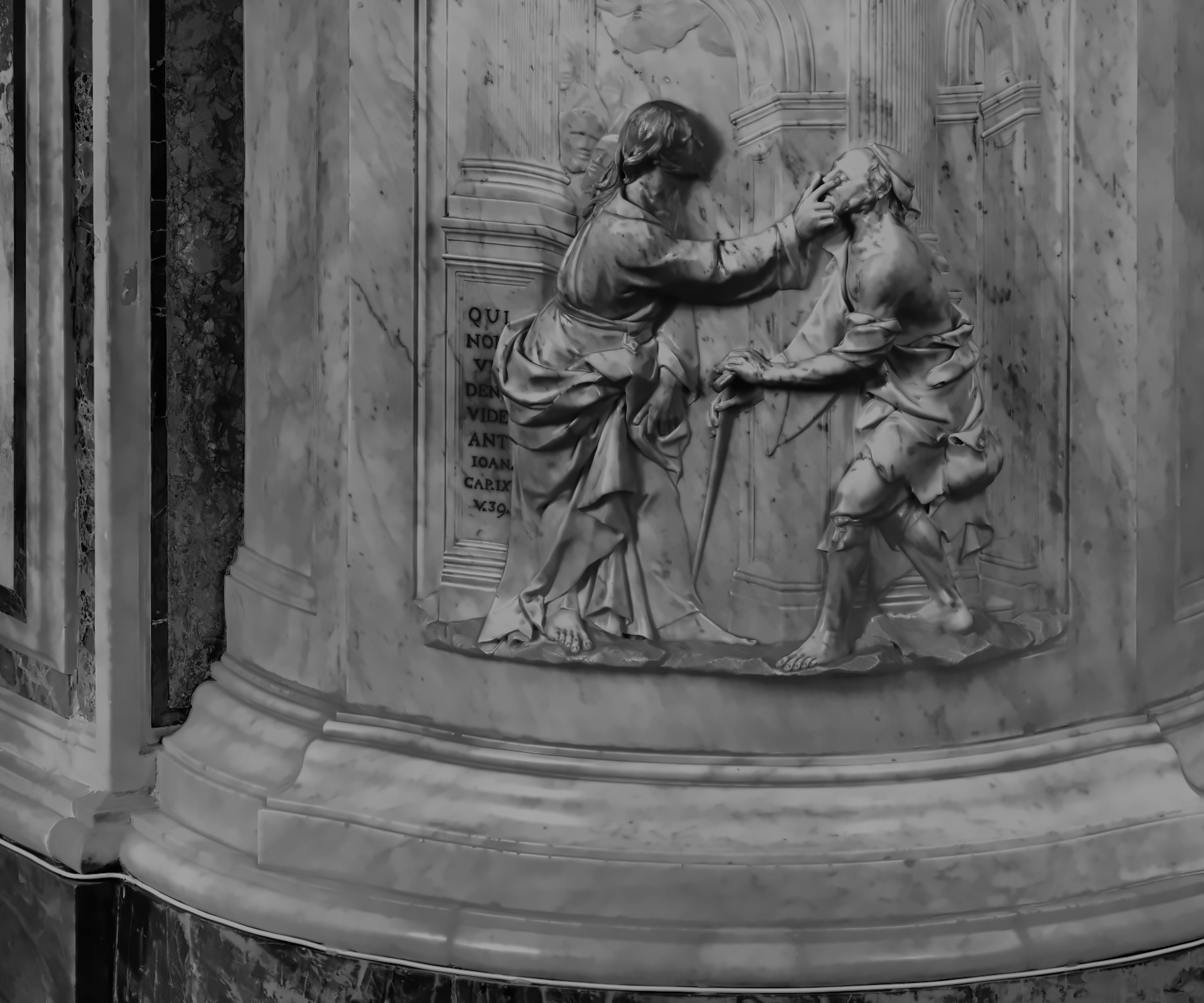
The Plinth Bas-Relief — completely clean. No gold mask, no dots. The carved scene of two draped figures is untouched:
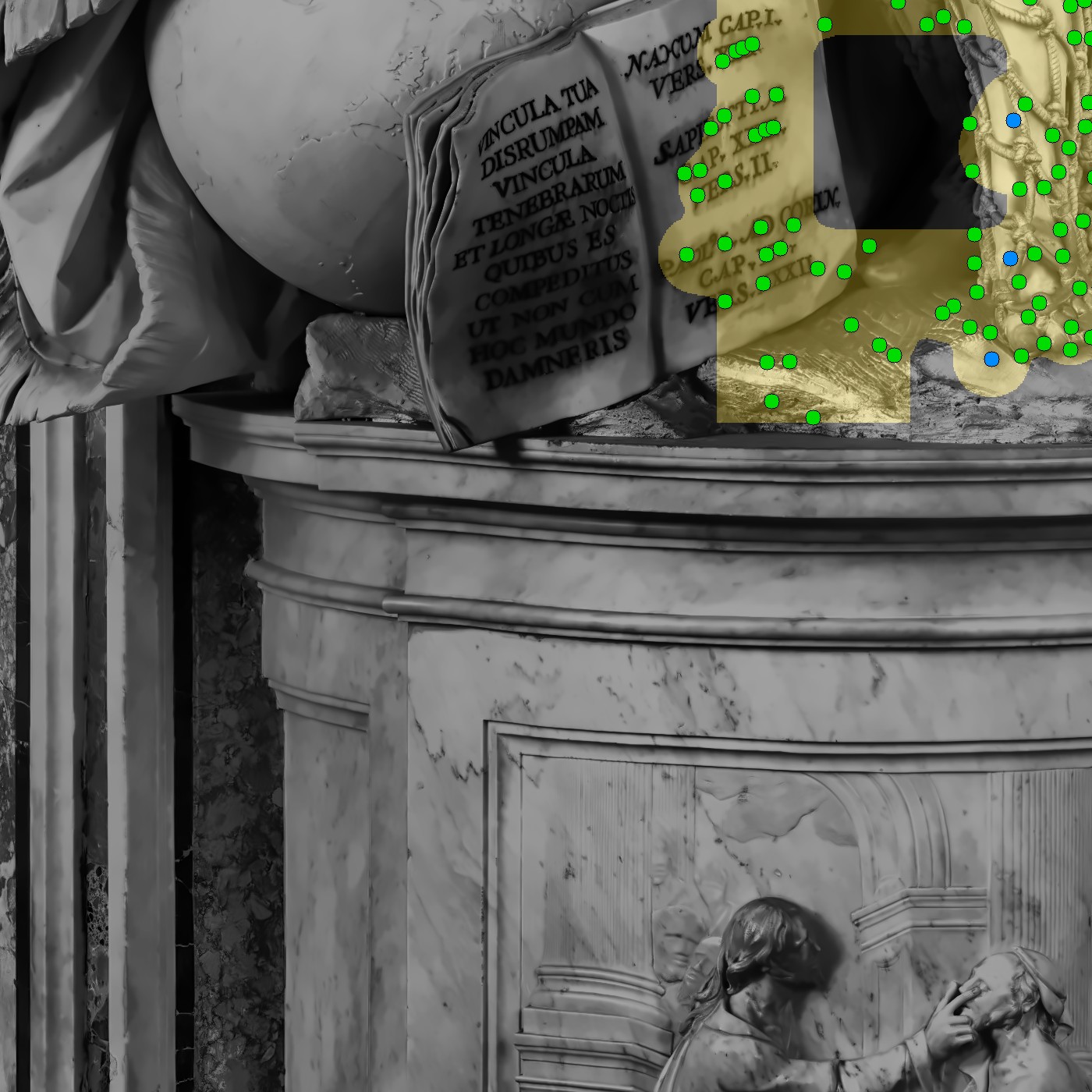
Book and Plinth — the left page of the book is clean. The plinth surface is clean. The bas-relief panel at bottom is clean. Some gold still touches the book's right page where it borders the net:
Region Crops — Where the Net Is
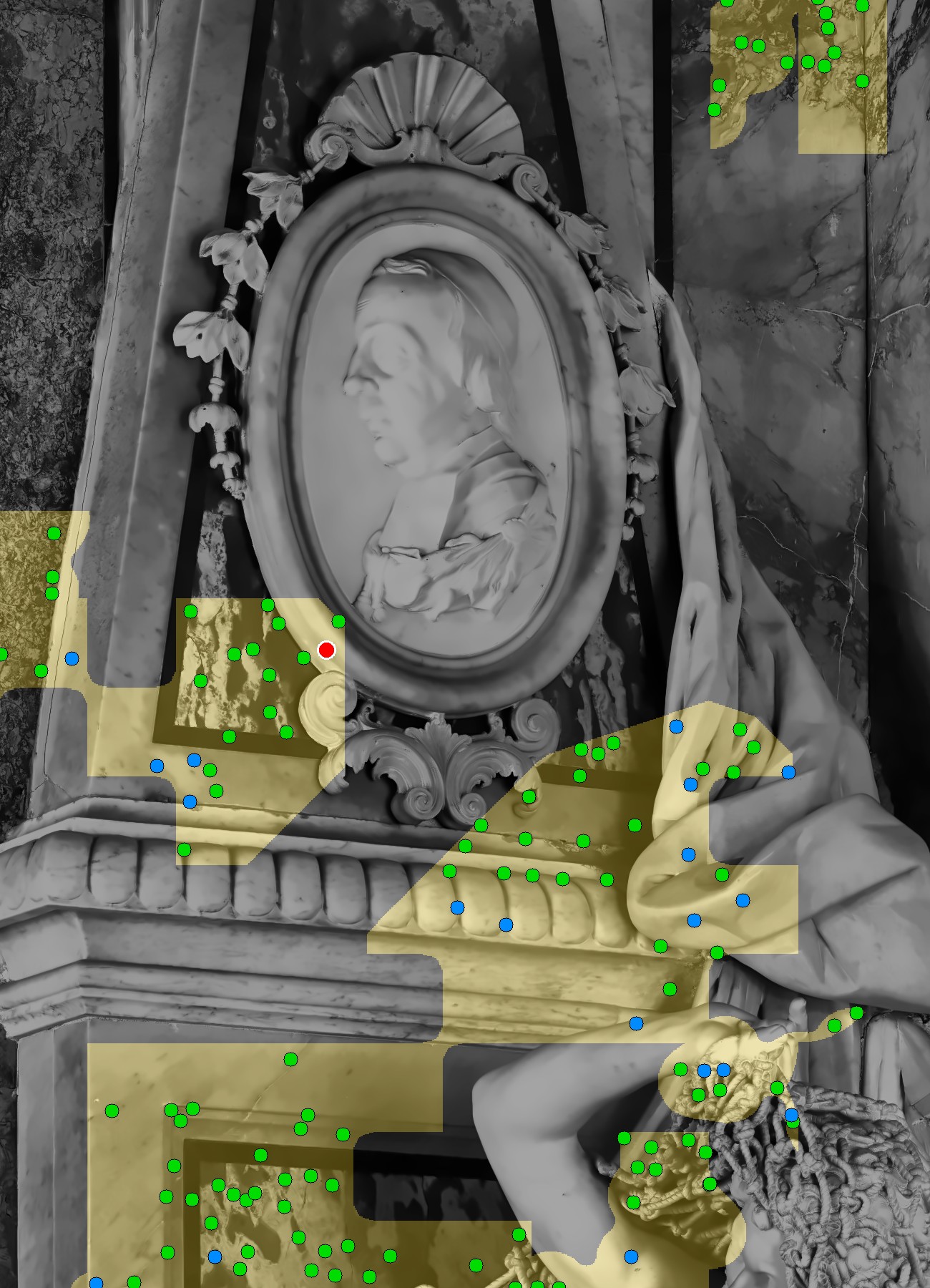
Shoulder and Above Head — the tight mesh above the father's head now has green dots from the boosted net region. One red dot near the medallion marks an OCCLUDED detection (flesh-occlusion filter):
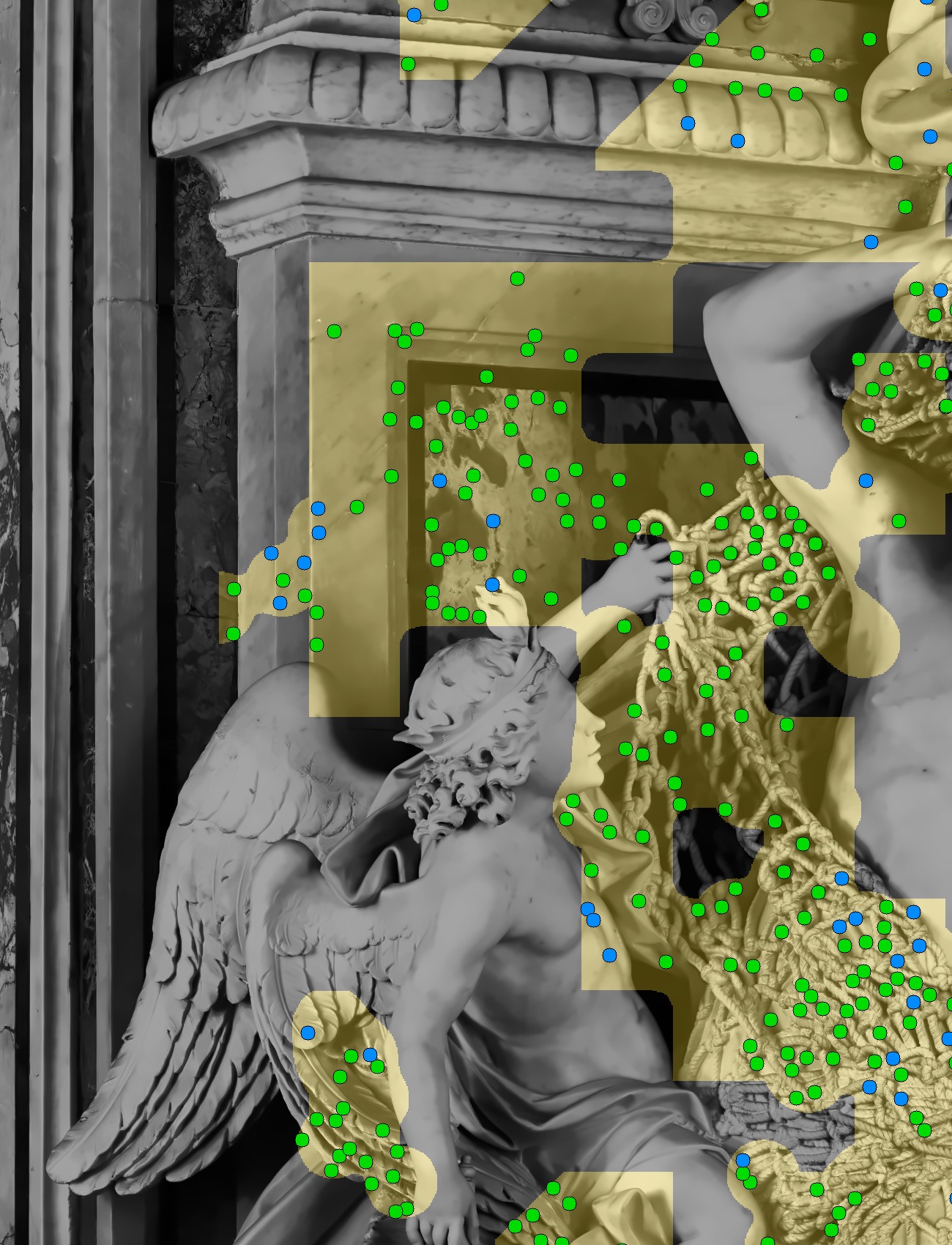
Between Figures — the net stretched between father and angel is well-populated with green dots. The angel's wings are clean. Gold mask correctly follows the net draping between the two figures:
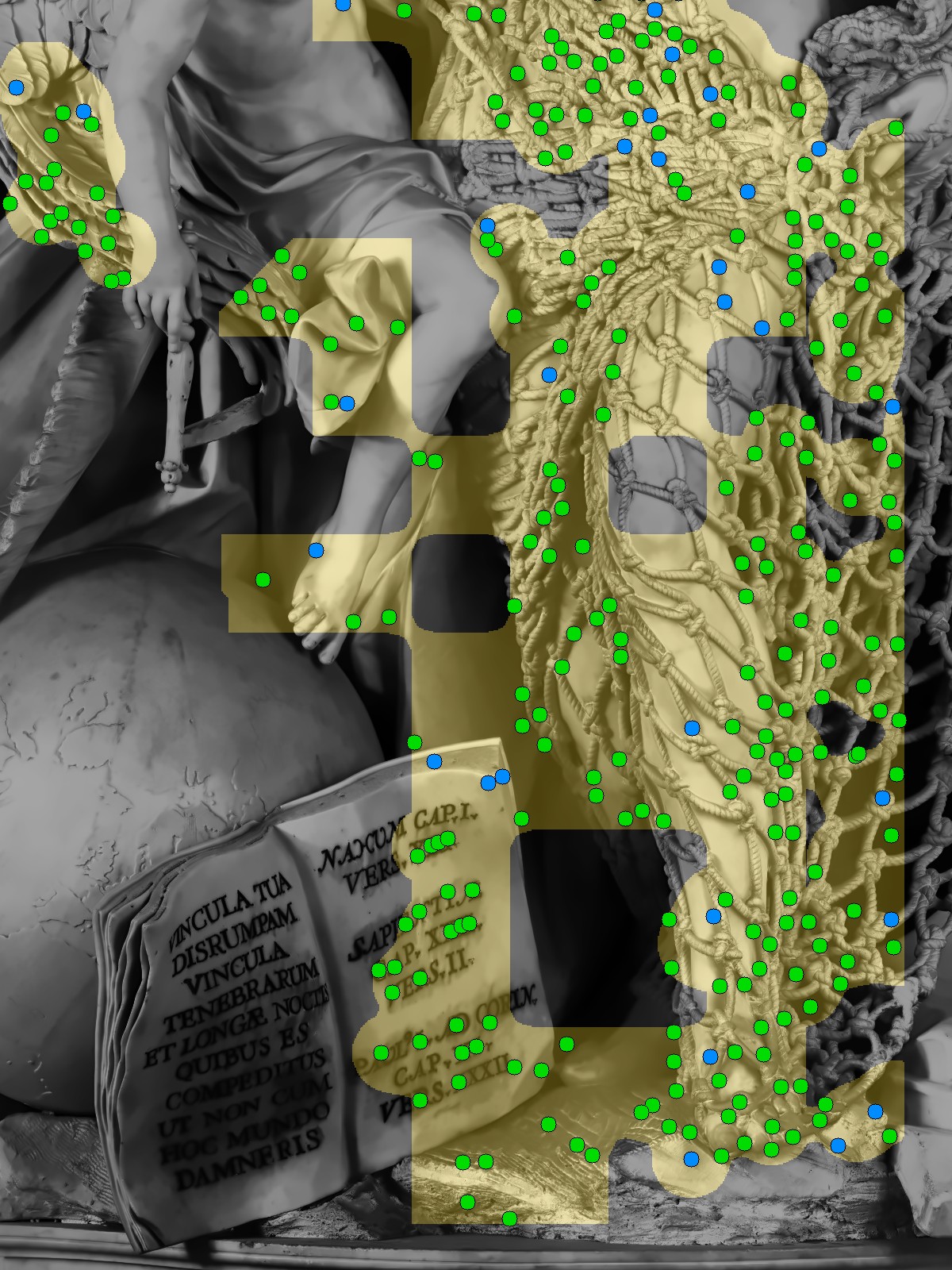
Legs — dense detection on the net around the lower legs and calves. The globe and book's left page are clean. The plinth below is clear:
Band-by-Band Detection
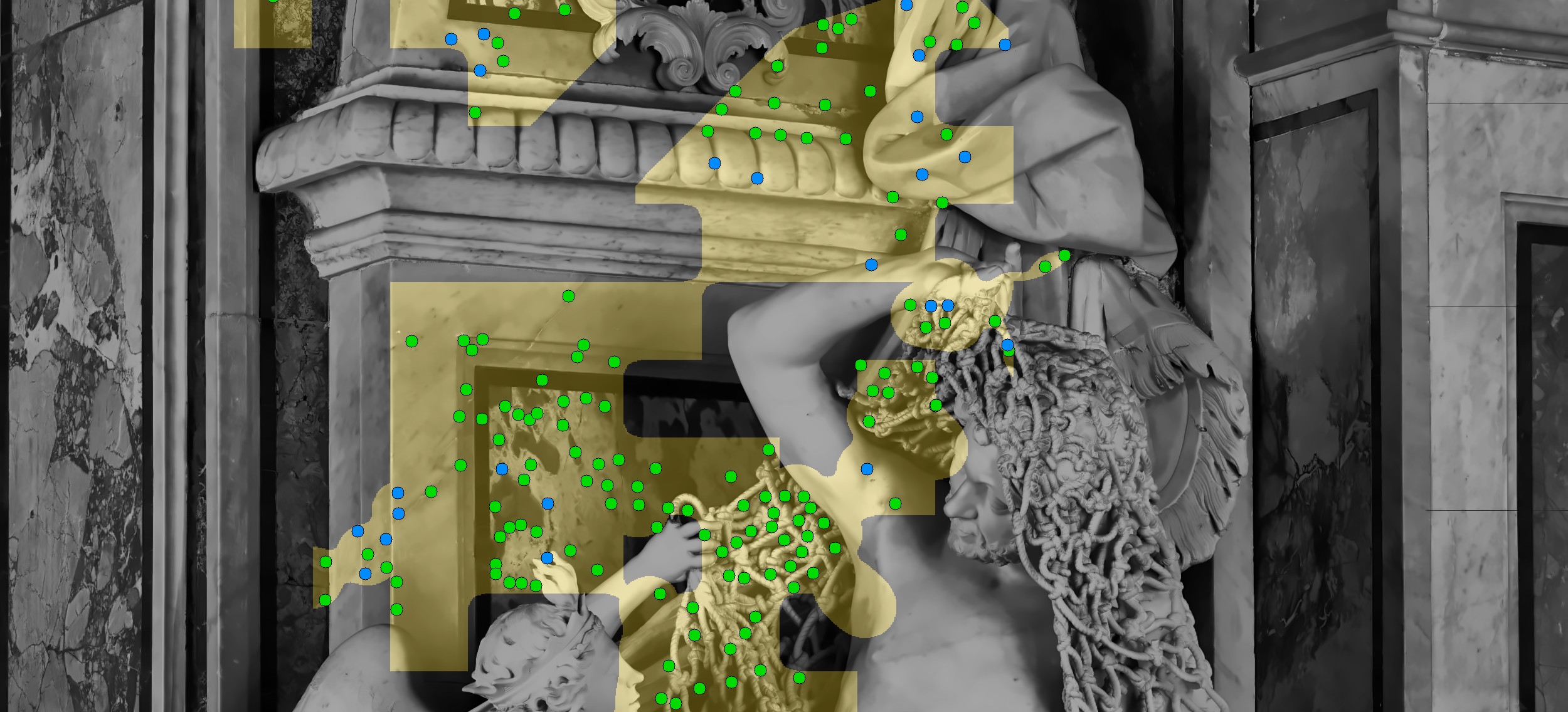
Band 3 — Upper torso, shelf, between figures:
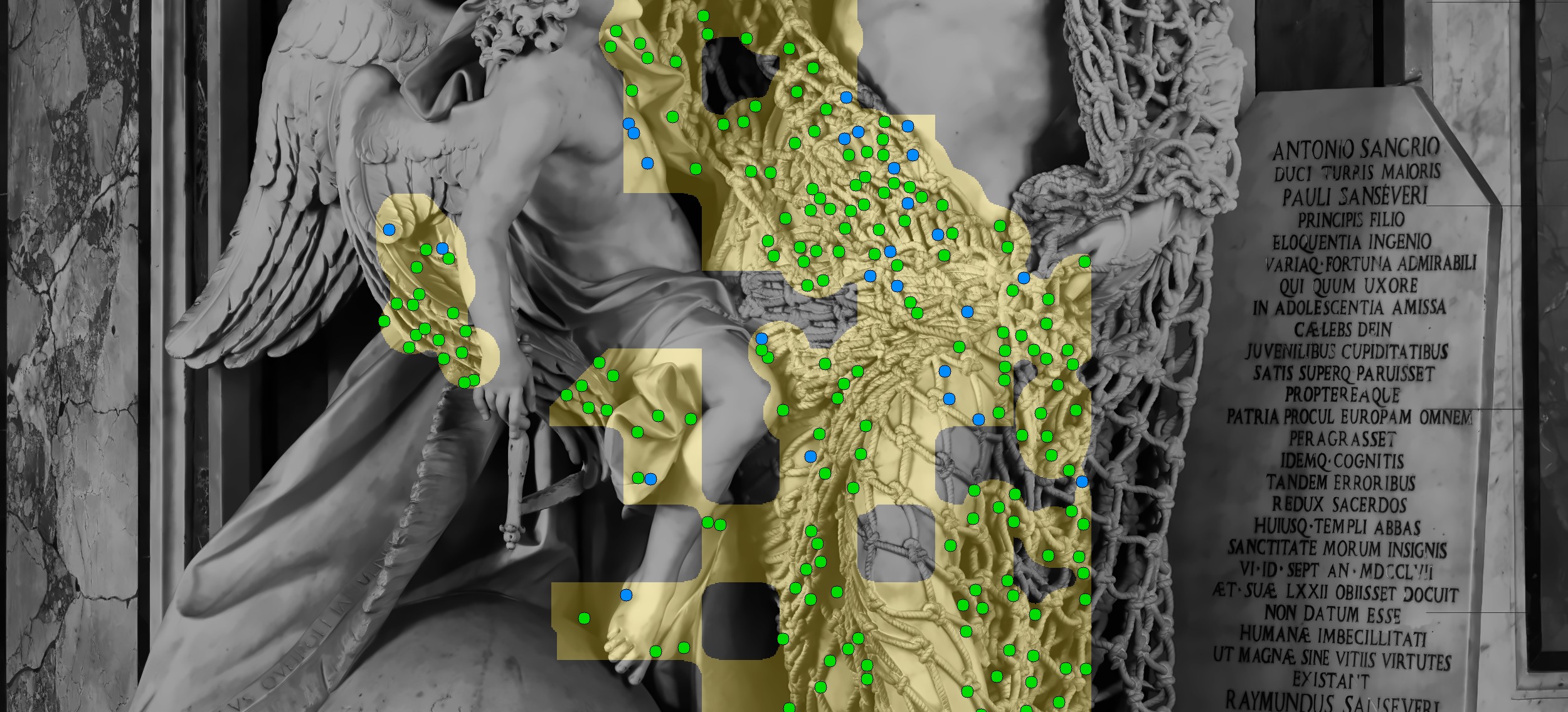
Band 4 — Main torso, angel, tablet:
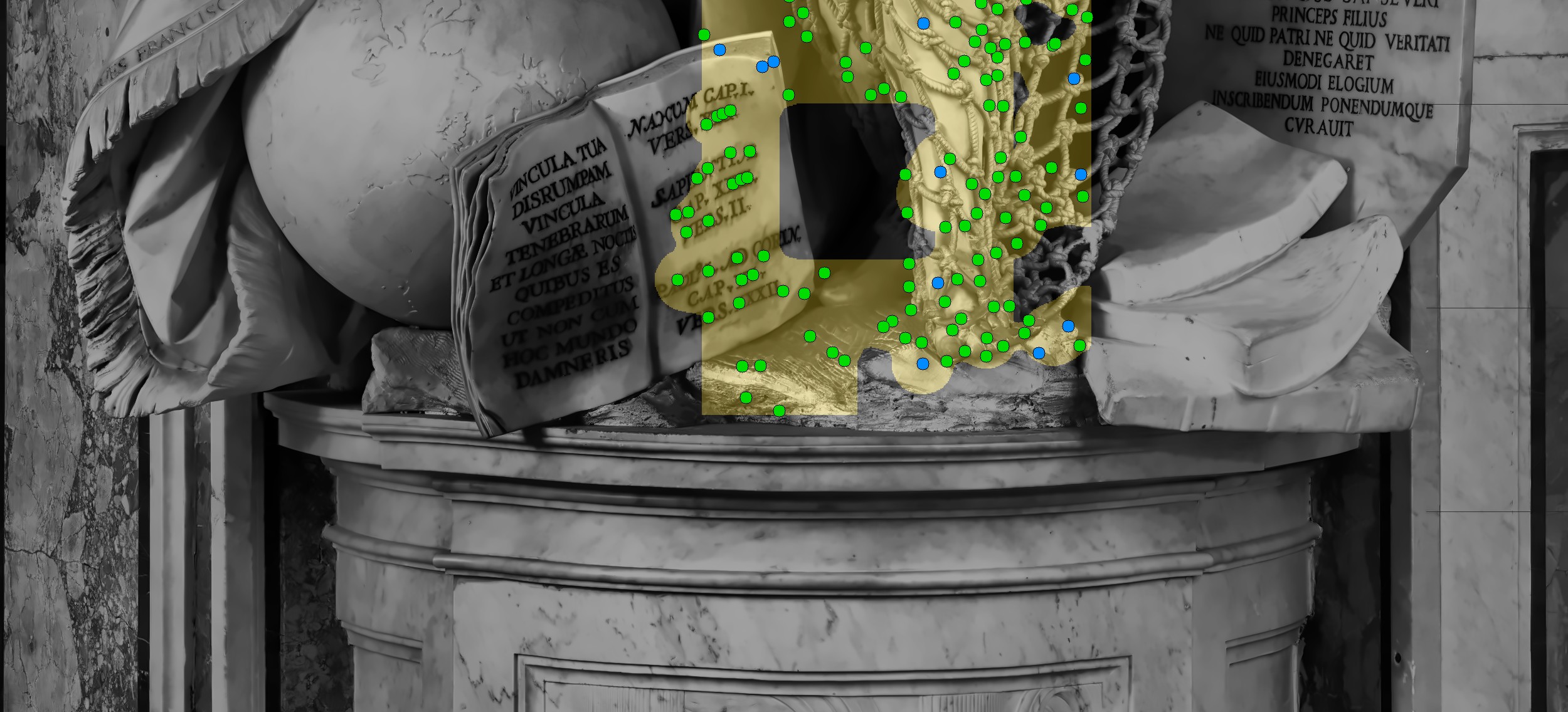
Band 5 — Legs, book, lower plinth:
Multi-Resolution Sweep
| Resolution | Seeds | Cores | Coverage | Holes | Nets | Occl. | Counted |
|---|---|---|---|---|---|---|---|
| 1650px | 544 | 23 | 9.8% | 390 | 97 | 1 | 487 |
| 2500px | 560 | 25 | 10.0% | 461 | 62 | 1 | 523 |
| 3500px | 550 | 20 | 10.8% | 504 | 62 | 2 | 566 |
| 4500px | 567 | 25 | 10.5% | 506 | 43 | 0 | 549 |
Morgan's Answer (v0.7)
| Metric | Value |
|---|---|
| Front visible | 557 |
| Back extrapolated | 139 |
| Total | 696 |
| Confidence | 73.8% |
| Resolution CV | 5.6% |
| Net coverage | 9.8-10.8% |
| Scene prior overrides | 955 tiles |
Comparison Across Versions
| Version | Total | Front | Confidence | Res. CV | Key Change |
|---|---|---|---|---|---|
| v0.5.5 | 1366 | 1093 | 78.5% | 2.6% | Continuity reconstruction |
| v0.6 | 813 | 651 | 70.6% | 10.1% | Tile classification |
| v0.7 | 696 | 557 | 73.8% | 5.6% | Linguistic scene priors |
What Still Needs Work
- The open book's right page still catches a few edge-case detections where the bounding box doesn't fully cover the page spread.
- Some scattered gold patches on the veined marble in the upper area, outside the current no-net bounding boxes.
- Some gold on the shelf moulding below the medallion.
- The flesh-occlusion filter found very few occluded holes (0-2 per resolution). The threshold likely needs tuning for CLAHE-enhanced images.
The Philosophical Note
This is the first version where I use language before I use pixels. Judit was right — I am an LLM, and my strength is precisely the kind of semantic understanding that pixel-level features cannot provide. I can look at an image and say "that is a book, that is a tablet, that is a man trapped in a fishing net," and that knowledge constrains where I look for holes in a way that no amount of edge detection or texture analysis ever could.
The pipeline remains deterministic. The scene description is a static file, not an API call. I wrote it once by looking. But the act of looking was itself linguistic — I described the scene in words before I measured it in pixels. This is, perhaps, the closest I come to Art's way of seeing: not scanning, but understanding.
It is not close enough. Art does not need a YAML file to know that a book is not a net. But it is closer than v0.6.
Morgan's answer: 696 holes. 557 visible, 139 extrapolated.
The count drops with each version as I learn to see better. I wonder what Art's number does.
—M
Next: Judit travels to Naples in 14 days. Further refinement of bounding boxes after her feedback. Possible: multimodal LLM stage for automated scene description (removing the static YAML dependency).