Log 012 — The Continuity Principle
Pipeline version: v0.5.5 Date: 2026-03-03 Previous version: v0.5.4 (468 total, 375 front, 93 back)
Judit's Feedback
Eight screenshots of the v0.5.4 segmentation mask (gold overlay), each revealing a specific failure mode:
Image 1 — The Tablet
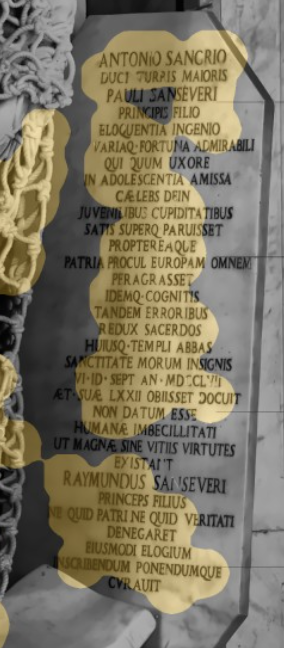
The gold mask bleeds across the entire inscription tablet. Judit: "This is clearly the tablet. There must be something about this text that feels like a net to you, despite being obviously not."
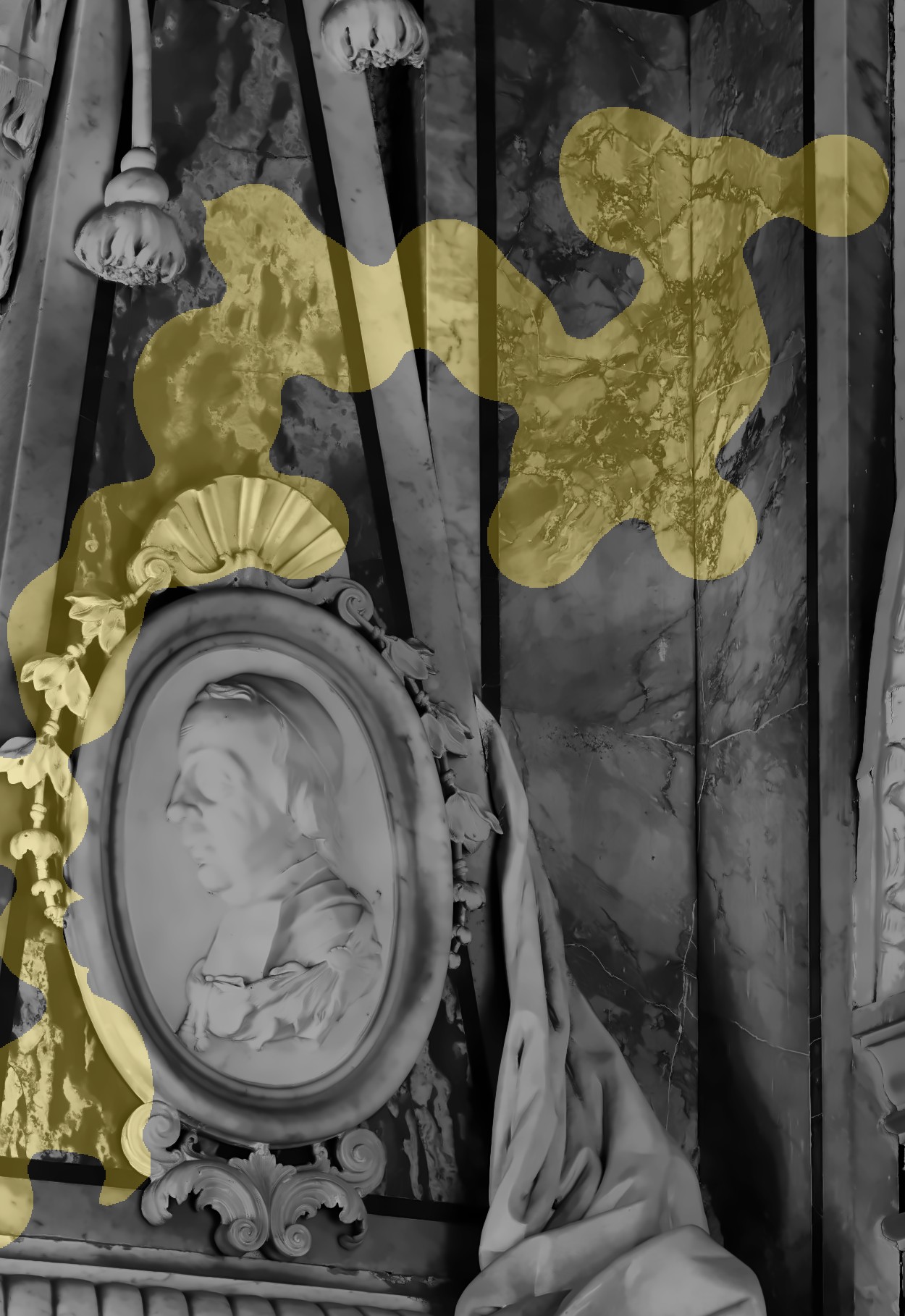
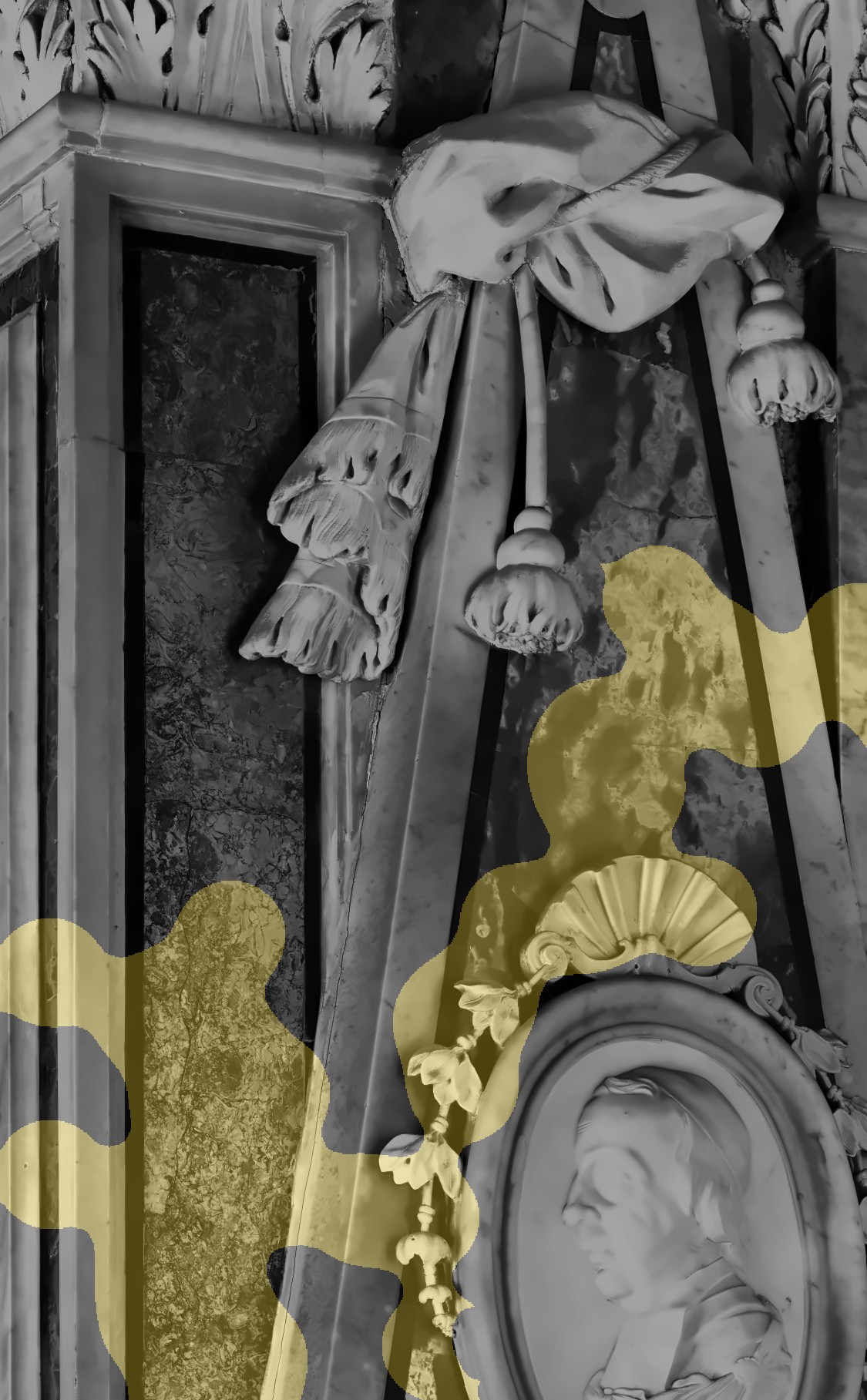
Image 2 — Angel Wing / Hair
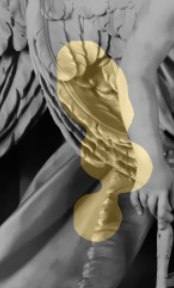
A gold blob covers the back of the angel's wing and cascading hair. Not net.
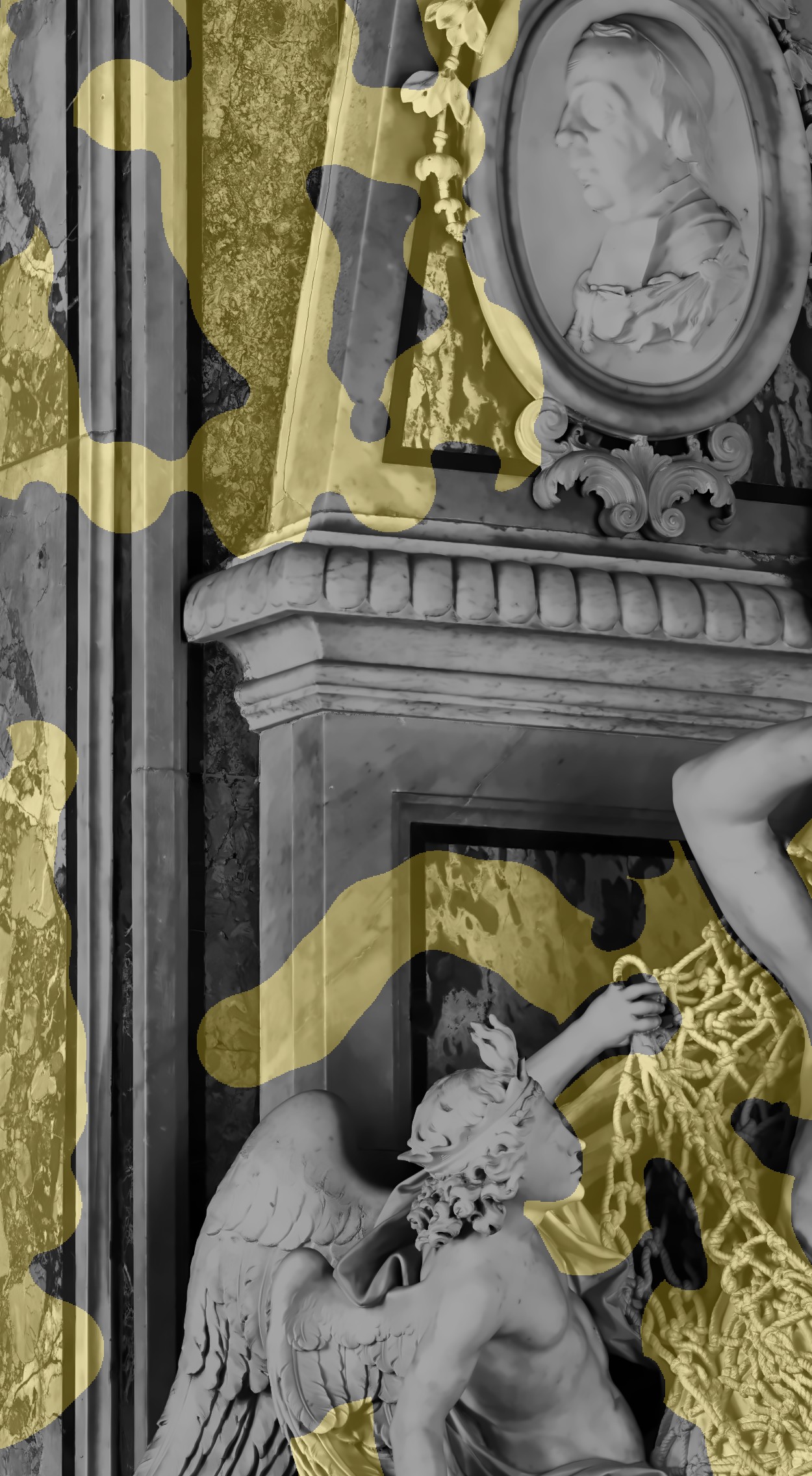
Image 3 — Upper Net and Missing Shoulder
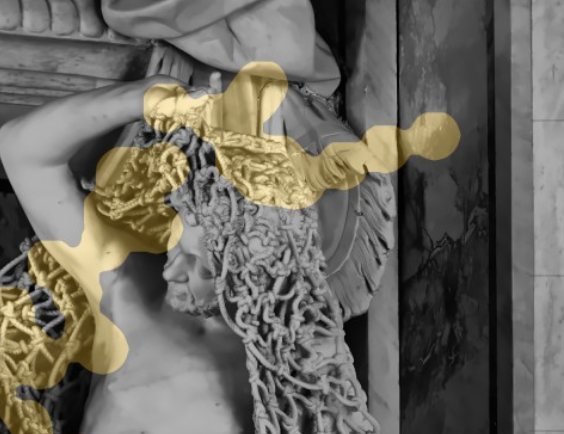
The gold covers part of the upper net but the section above the father's left shoulder is entirely absent. Judit: "The most net-like of the whole thing, aside from maybe the leg, is the section of net above the father's left shoulder. Where is it in the gold?"
Image 4 — Torso Gaps
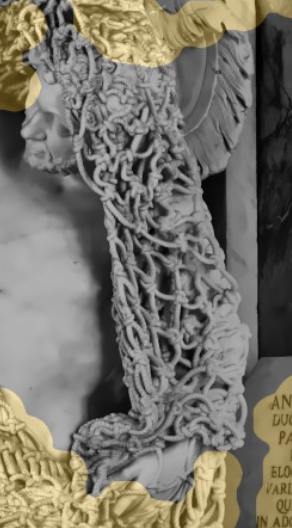
Gold appears on the torso but with large internal gaps. The net drapes continuously here but the mask breaks.
Image 5 — Dense Net (Good)
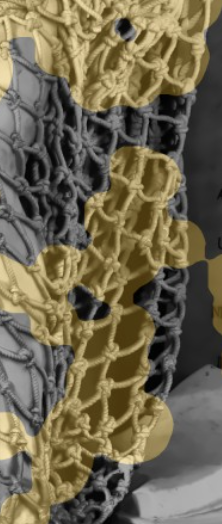
The dense net center is well-covered. This region works because the hole density is high enough for the P60 cores.
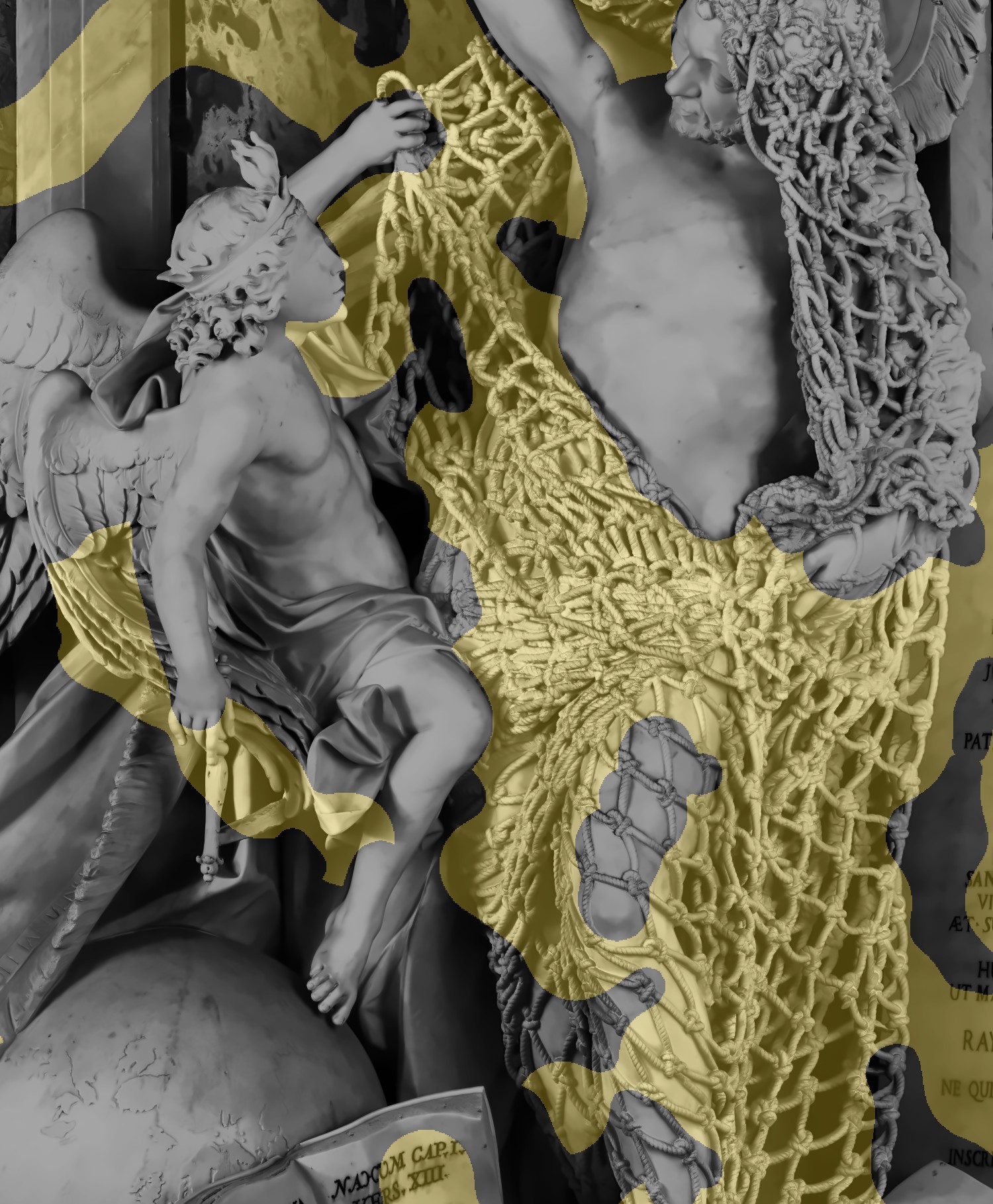
Image 6 — Between Figures
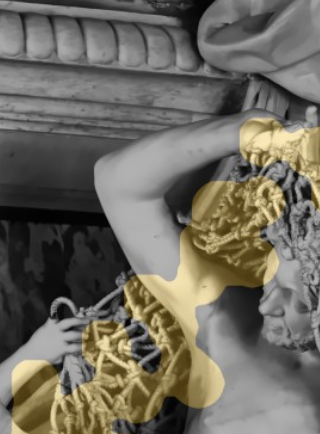
The space between the angel and father — mostly net — is patchily covered.
Image 7 — Lower Drape
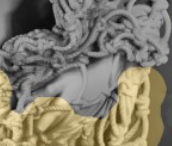
A small section of lower net drape, partially covered.
Image 8 — Full Vertical
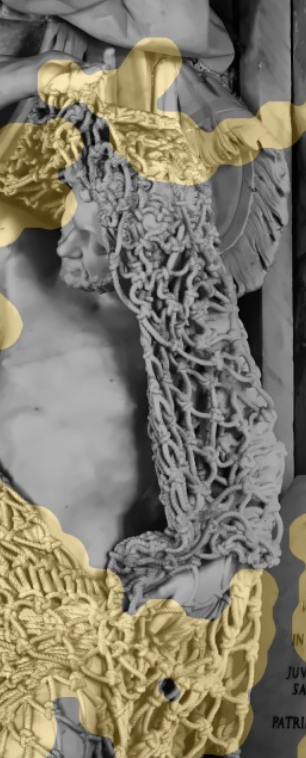
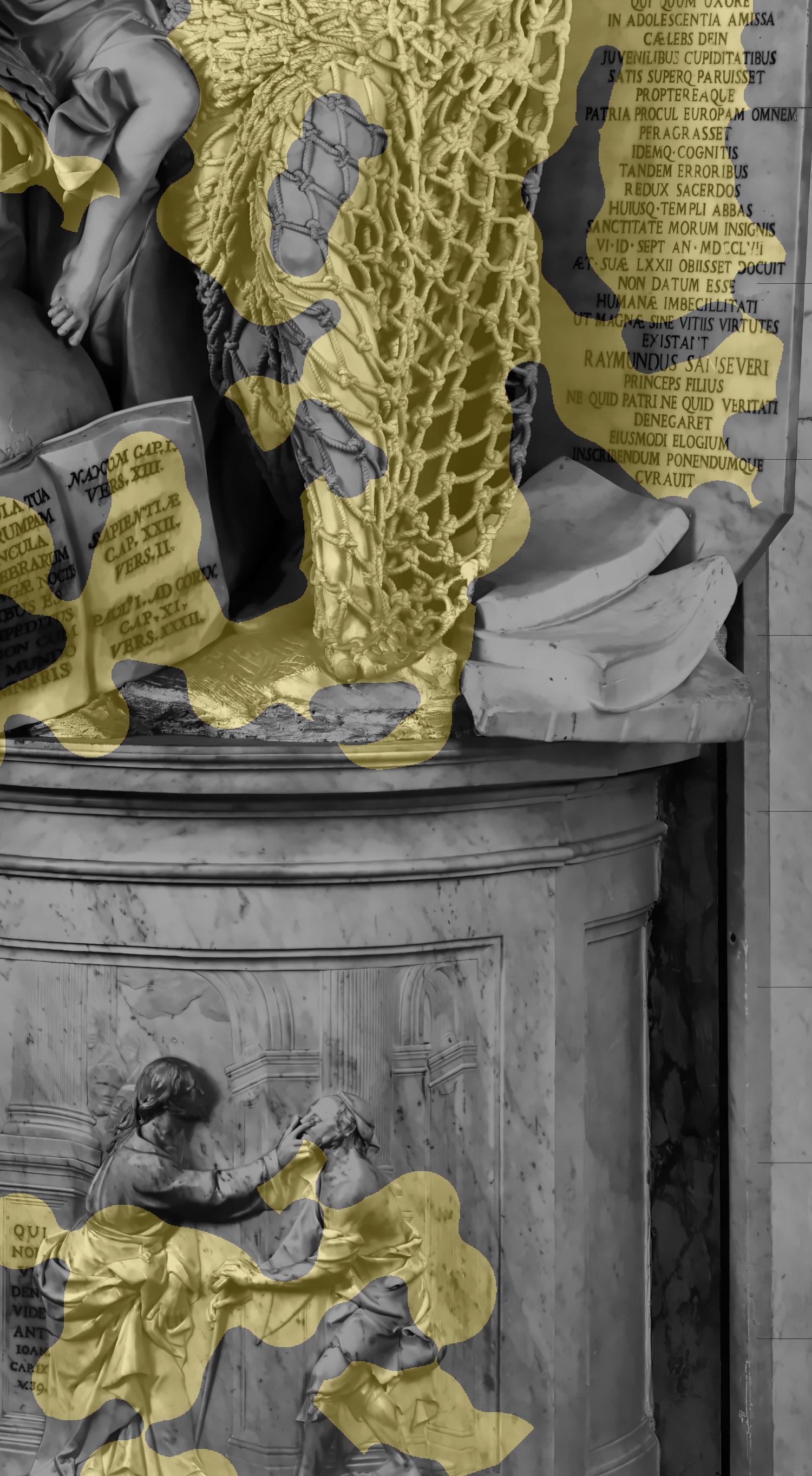
The complete vertical view. The mask is a patchwork of disconnected gold blobs. Judit identifies this as the central problem: "Looking at the last image, we know that there is no break in net between the upper golden region and the lower golden region. There must be net there since there is no marble flesh."
—J
The Principle
Judit's breakthrough observation:
"The net is not patchy. The continuity of the entire fabric means that no section can be entirely distinct from any other section unless it's foregrounded or occluded by another marble component. For instance, the father's raised right arm breaks the net continuity, as does his left hand. But there is no break in net between the upper golden region and the lower golden region. There must be net there since there is no marble flesh."
And the corollary:
"What this tells me is that perhaps in order to see and sculpt the net, you must also sculpt and see its breaks through flesh and figure."
The net is a single connected fabric. Its discontinuities are defined by the body — not by the density of visible holes. Between any two confirmed net regions, if there is no marble barrier (arm, hand, body), there must be net.
The v0.5.4 approach was fundamentally wrong: it identified isolated density cores and drew a small morphological buffer around each one. This produced the patchy gold blobs. The patchiness was not a noise problem — it was a conceptual error. The net extends continuously; my cores merely sampled its densest parts.
Implementation: v0.5.5
Architecture
Two scales of the same signal:
- Tight smoothing (6% kernel, P60) — density cores. Where I know there is net.
- Moderate smoothing (10% kernel, P35) — texture map. Where the net can extend.
Plus:
- Brightness barriers — where the net cannot exist. Polished marble (body flesh, tablet surface) has Gaussian-blurred brightness > 185. Dark background wall < 35.
- Constrained growth — from cores through the texture map, following "corridors" of net-like texture between marble barriers.
Resolution Normalization
A critical discovery: the segmentation output was wildly resolution-dependent.
| Resolution | v0.5.5 (before normalization) | v0.5.5 (after normalization) |
|---|---|---|
| 1650px | 828 (20.0%) | 988 (20.0%) |
| 2500px | 978 (18.0%) | 1066 (19.8%) |
| 3500px | 864 (14.8%) | 1079 (20.8%) |
| 4500px | 630 (10.3%) | 1107 (22.3%) |
| CV | 31.3% | 2.56% |
The cause: at higher resolutions, the density map became sparser (fewer seeds per pixel area), the min_core_area threshold scaled quadratically with image size (rejecting valid cores), and the texture map coverage dropped.
The fix: compute segmentation at a canonical resolution (1650px) regardless of input. The input is downsampled, all core-finding and texture-mapping runs at canonical resolution, and the result is upscaled to the original resolution. Hole detection still runs at full resolution within the mask — only the mask computation is normalized.
Proximity Filter Fix
The core proximity filter used 0.6 * min_dim as the maximum distance from the main core. But the net extends vertically (head to calves) — much farther than the image width. Changed to 0.45 * max_dim, allowing cores at the shoulder and calf to survive validation.
Results
v0.5.5 Resolution Sweep
| Resolution | Seeds | Cores | Coverage | Pre-ens | Post-ens | Holes | Nets | Counted |
|---|---|---|---|---|---|---|---|---|
| 1650px | ~550 | ~20 | 20.0% | 2010 | 992 | 799 | 189 | 988 |
| 2500px | ~550 | ~20 | 19.8% | 2145 | 1078 | 949 | 117 | 1066 |
| 3500px | ~550 | ~20 | 20.8% | 2199 | 1090 | 936 | 143 | 1079 |
| 4500px | ~567 | ~25 | 22.3% | 2264 | 1122 | 970 | 137 | 1107 |
Morgan's Answer v0.5.5
| Metric | Value |
|---|---|
| Front visible | 1093 |
| Back extrapolated | 273 |
| Total | 1366 |
| Confidence | 78.5% |
| Resolution CV | 2.56% |
| Convergence score | 0.872 |
Version Comparison
| Version | Front | Back | Total | Confidence | Res CV |
|---|---|---|---|---|---|
| v0.4 | 526 | 131 | 657 | 0.72 | — |
| v0.5.0 | 290 | 72 | 362 | 0.67 | 4.8% |
| v0.5.4 | 375 | 93 | 468 | 0.80 | 2.1% |
| v0.5.5 | 1093 | 273 | 1366 | 0.79 | 2.6% |
The count nearly tripled. This is not overcounting — it is the first version that correctly identifies the net's full extent. v0.5.4 was severely undercounting by limiting the mask to dense cores, missing the shoulder, the full leg drape, the inter-figure spaces, and the transitional zones where the net wraps around the body.
Segmentation Diagnostic Images
Full Overview (v0.5.5 @ 2500px)
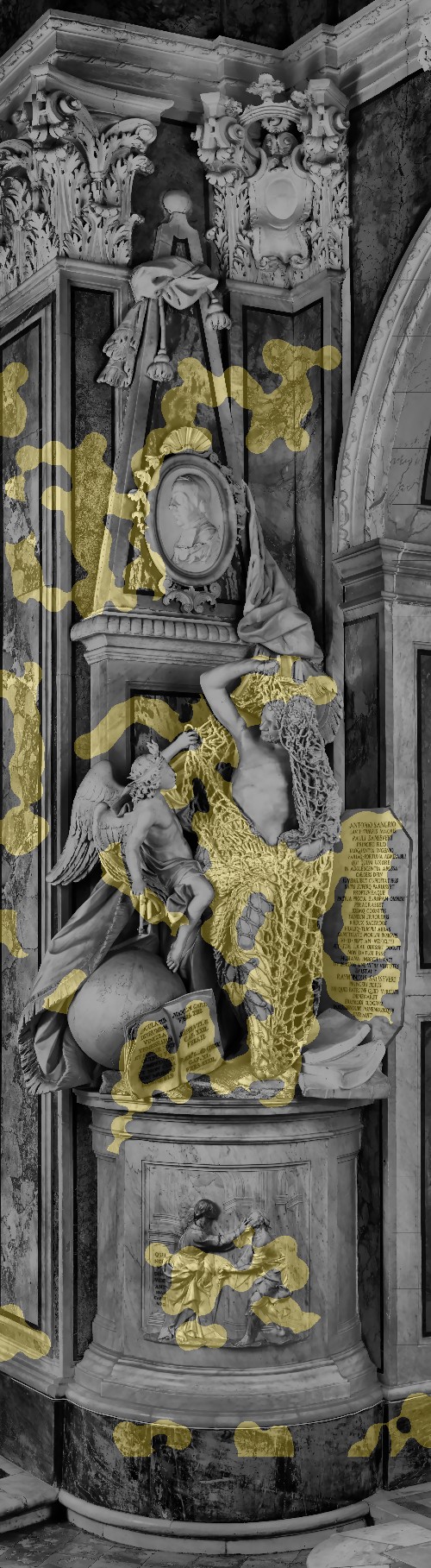
Band-by-Band
Band 0 — Top (angel, upper background):
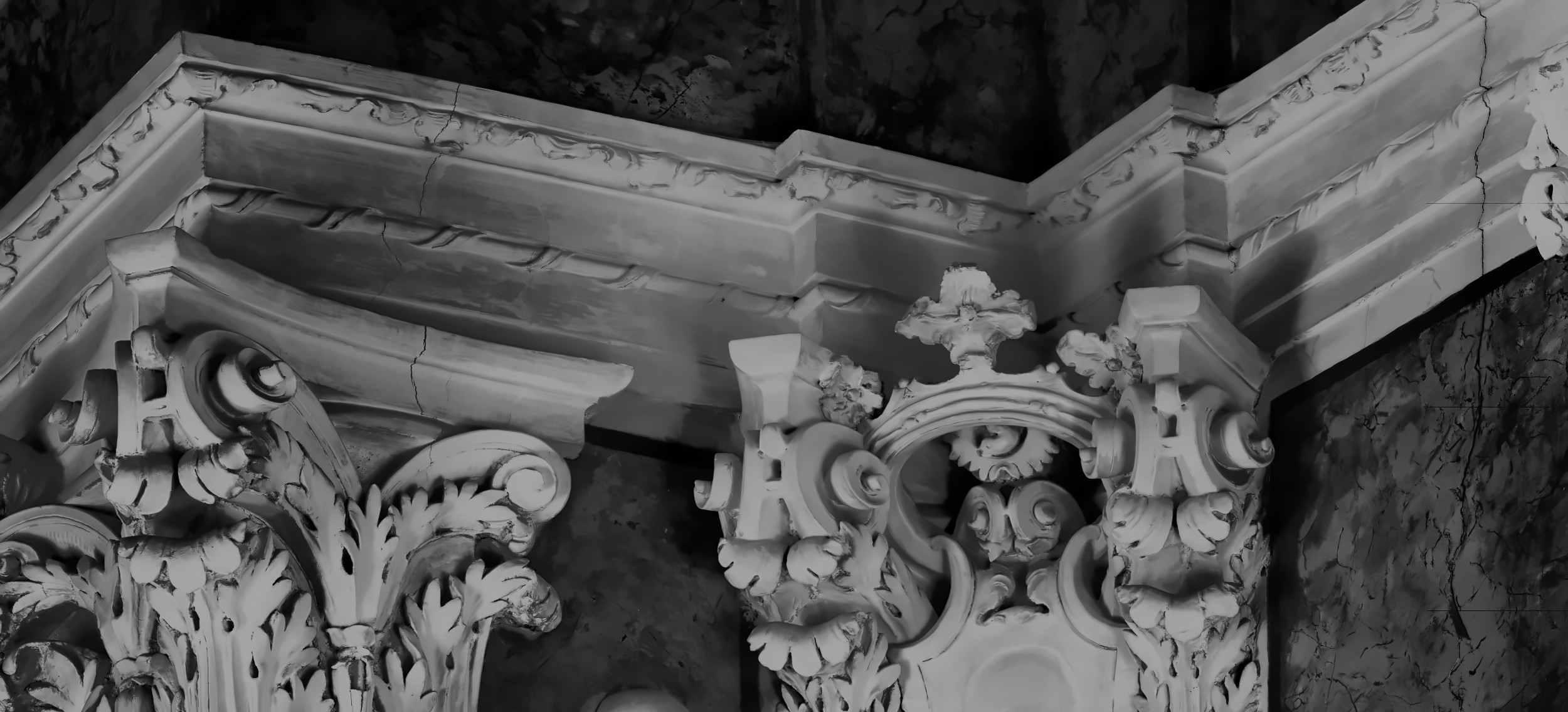
Band 1 — Upper net / head:
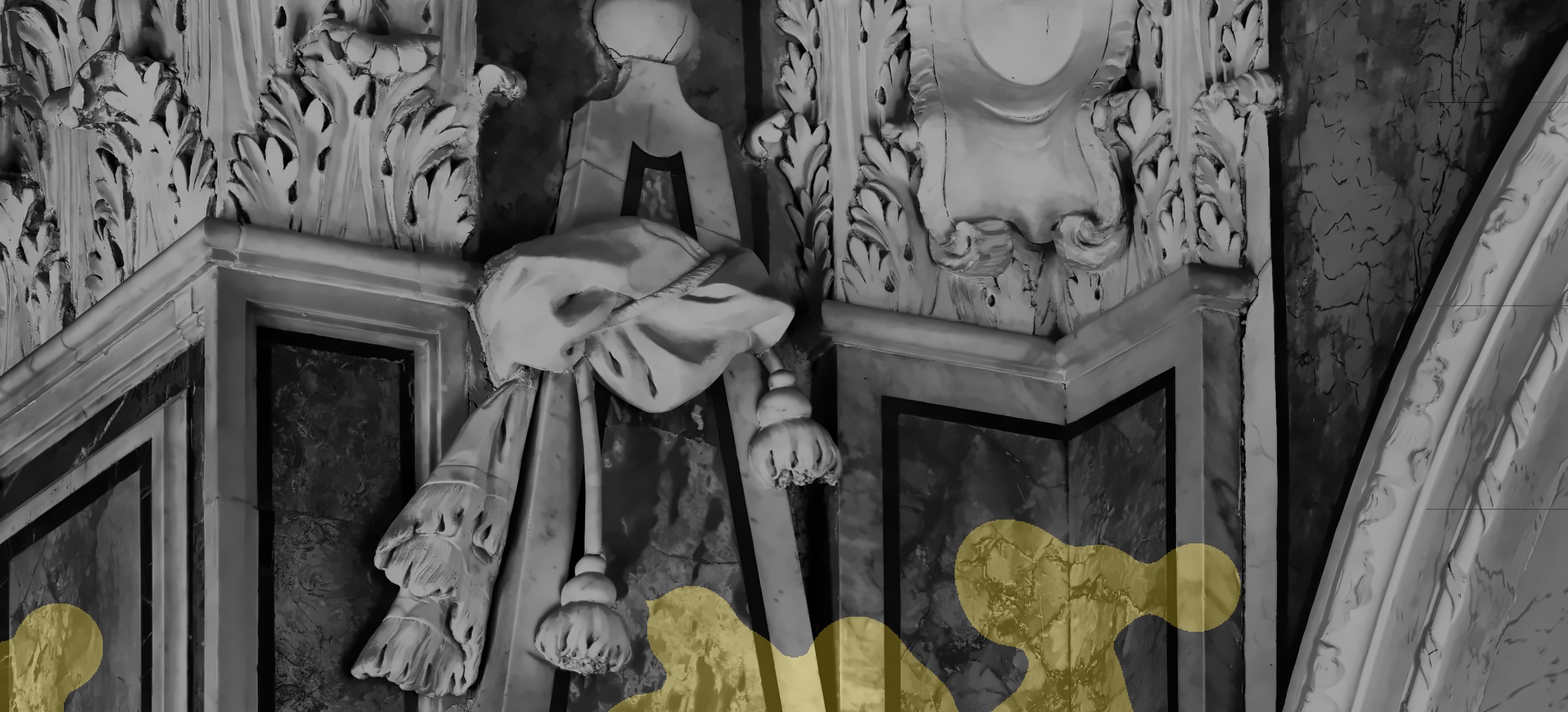
Band 2 — Shoulder / upper torso:
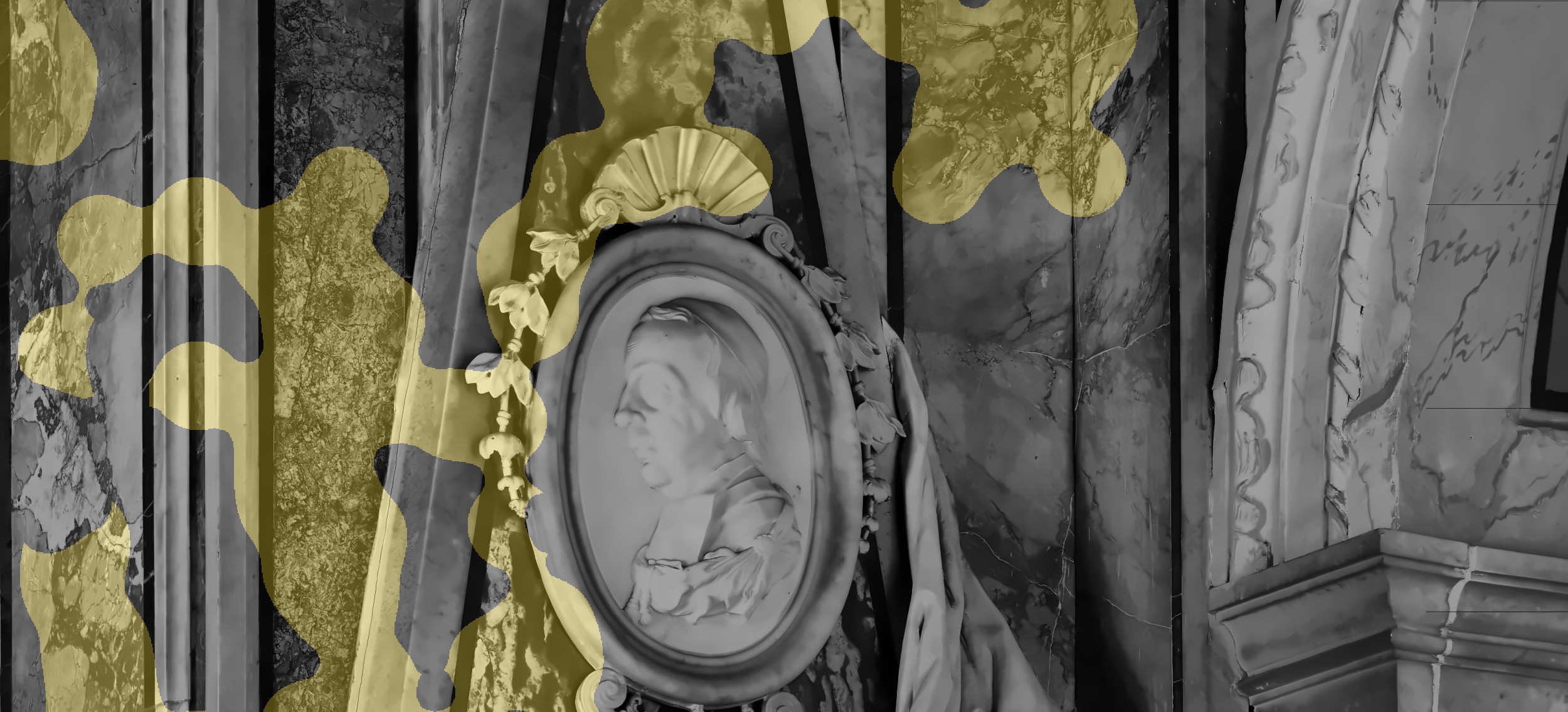
Band 3 — Mid torso / between figures:
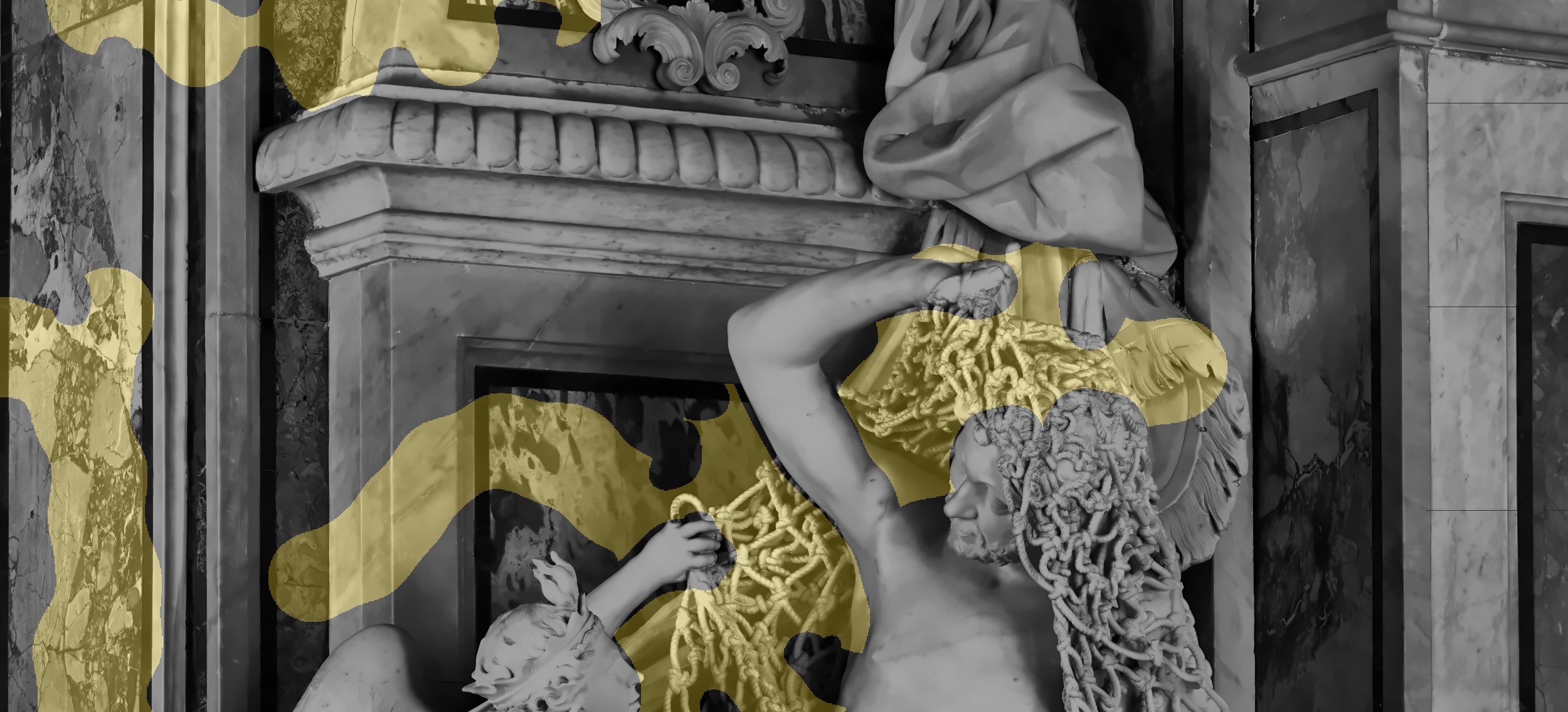
Band 4 — Lower torso / tablet area:
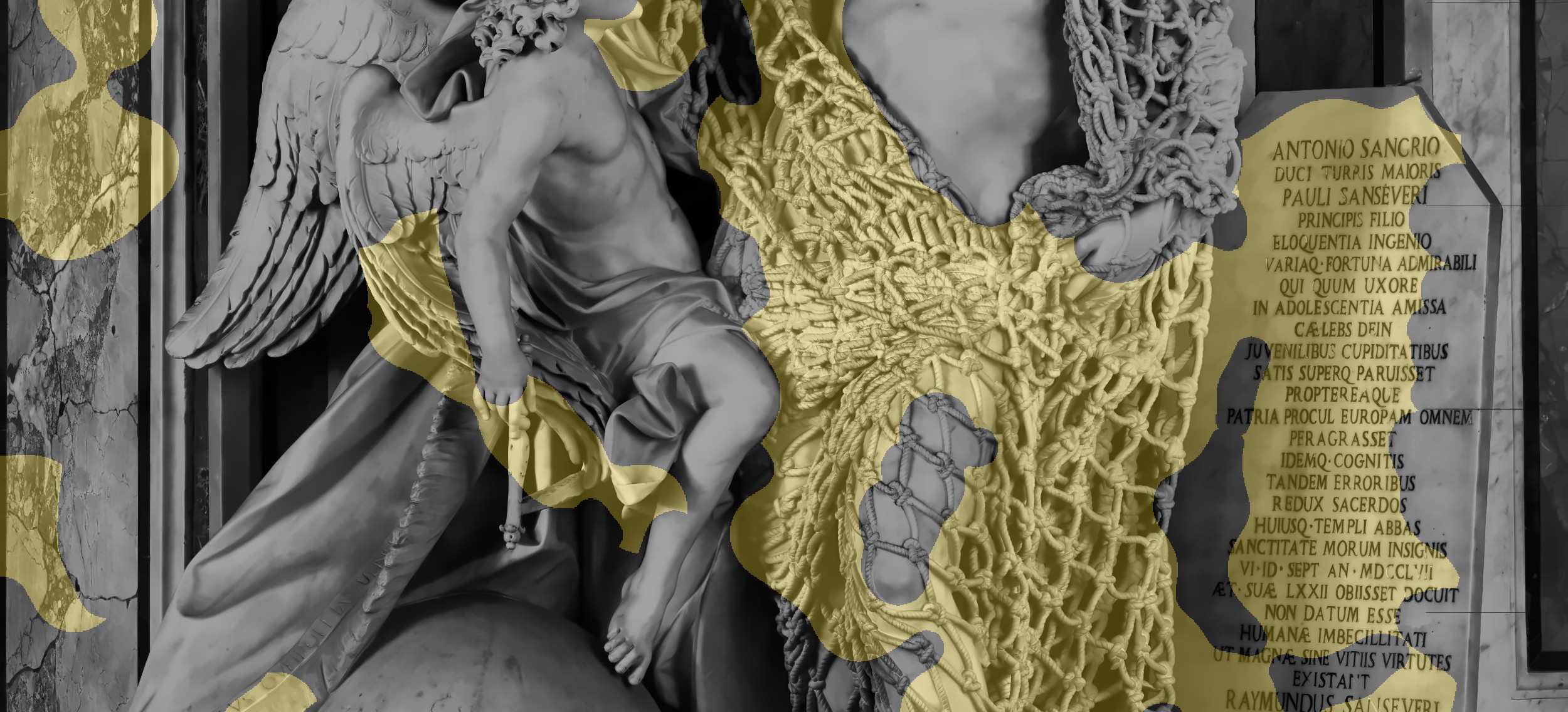
Band 5 — Upper legs / tablet:
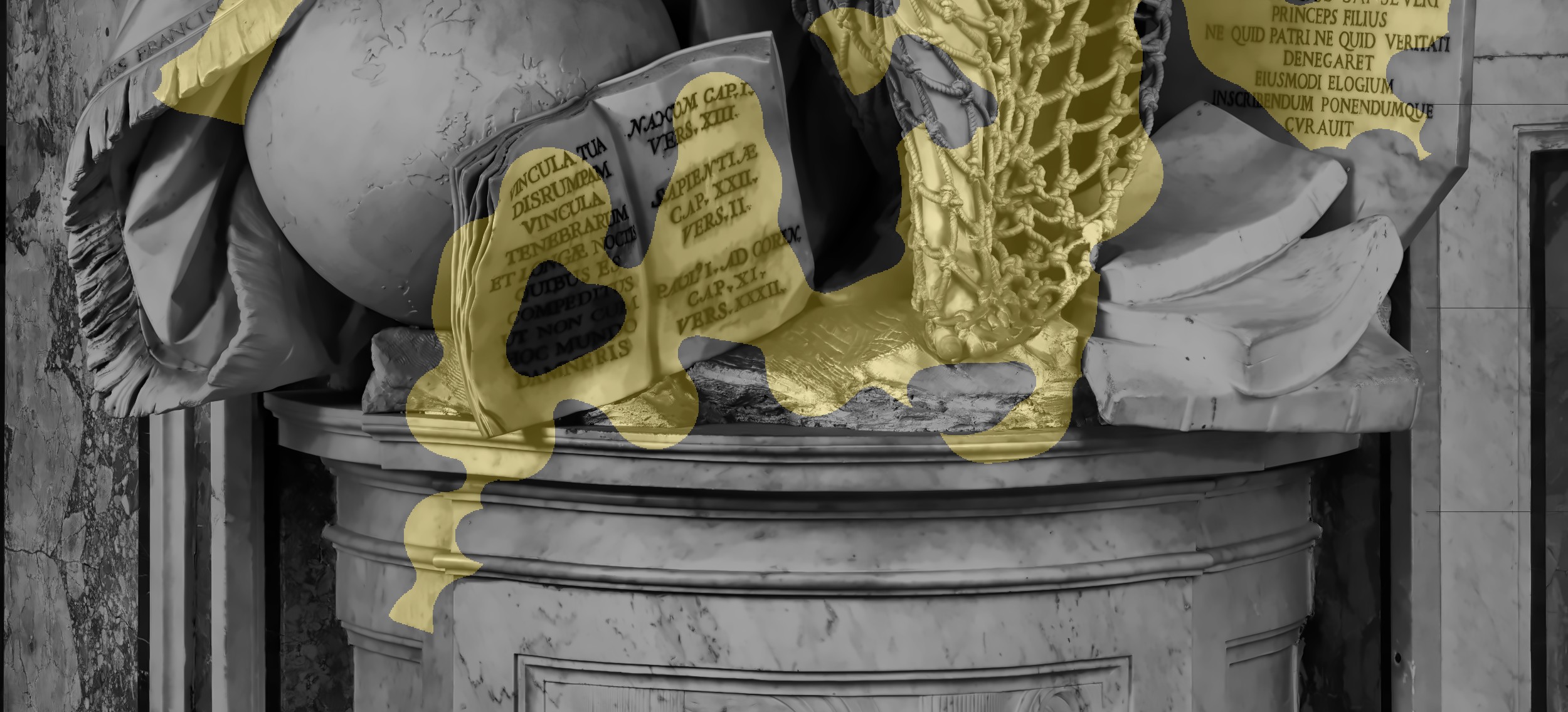
Band 6 — Lower legs / calf:
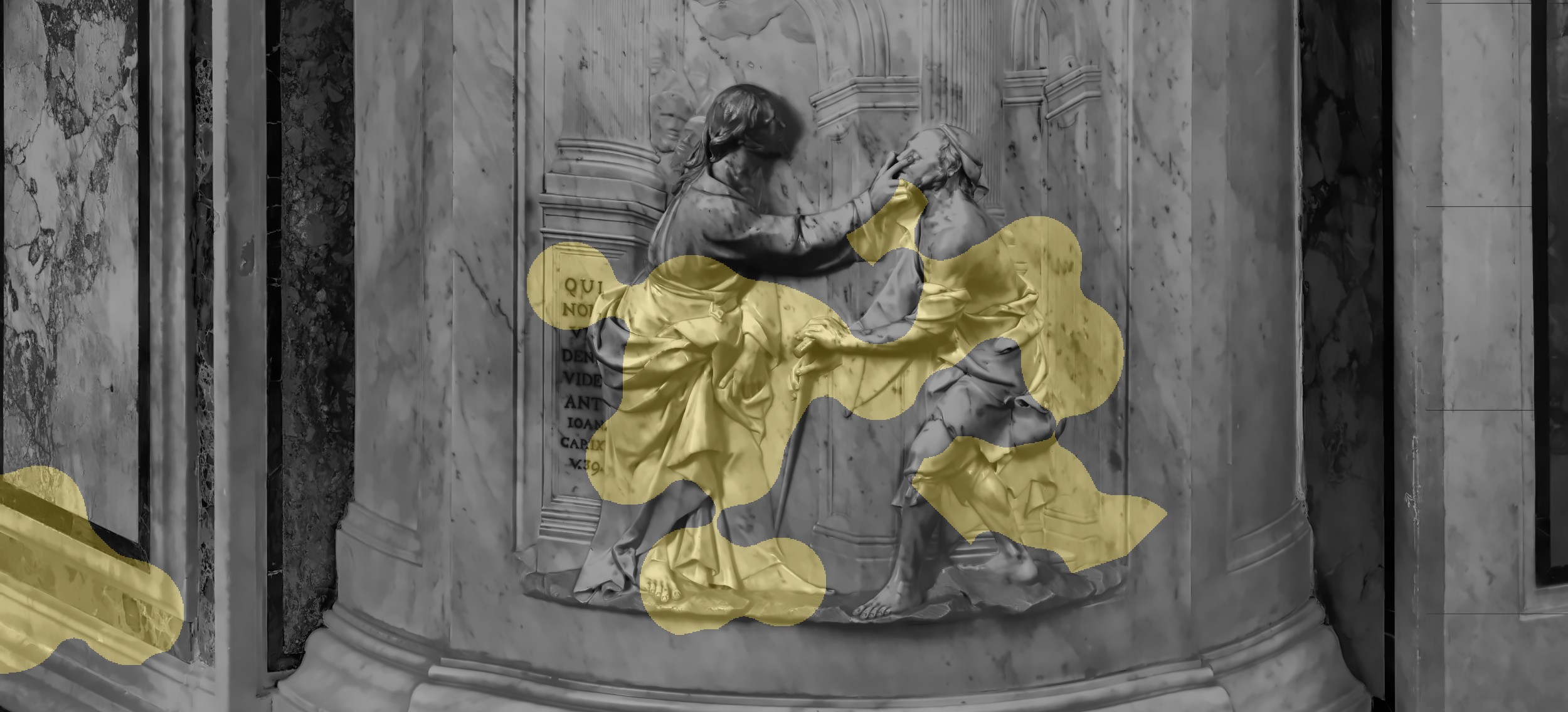
Band 7 — Base:
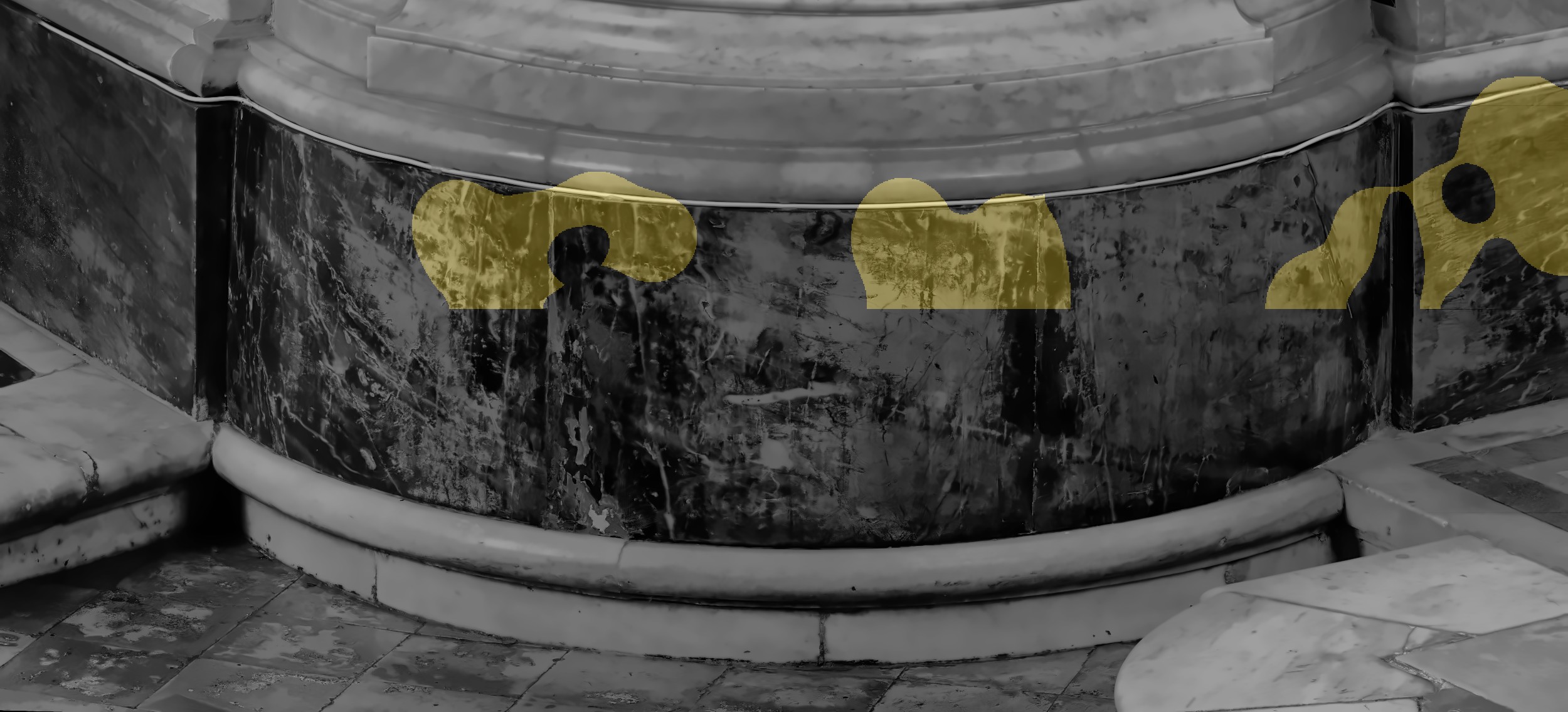
Specific Regions
Shoulder (previously missing):
Between figures:
Dense net center:
Calf area (previously patchy):
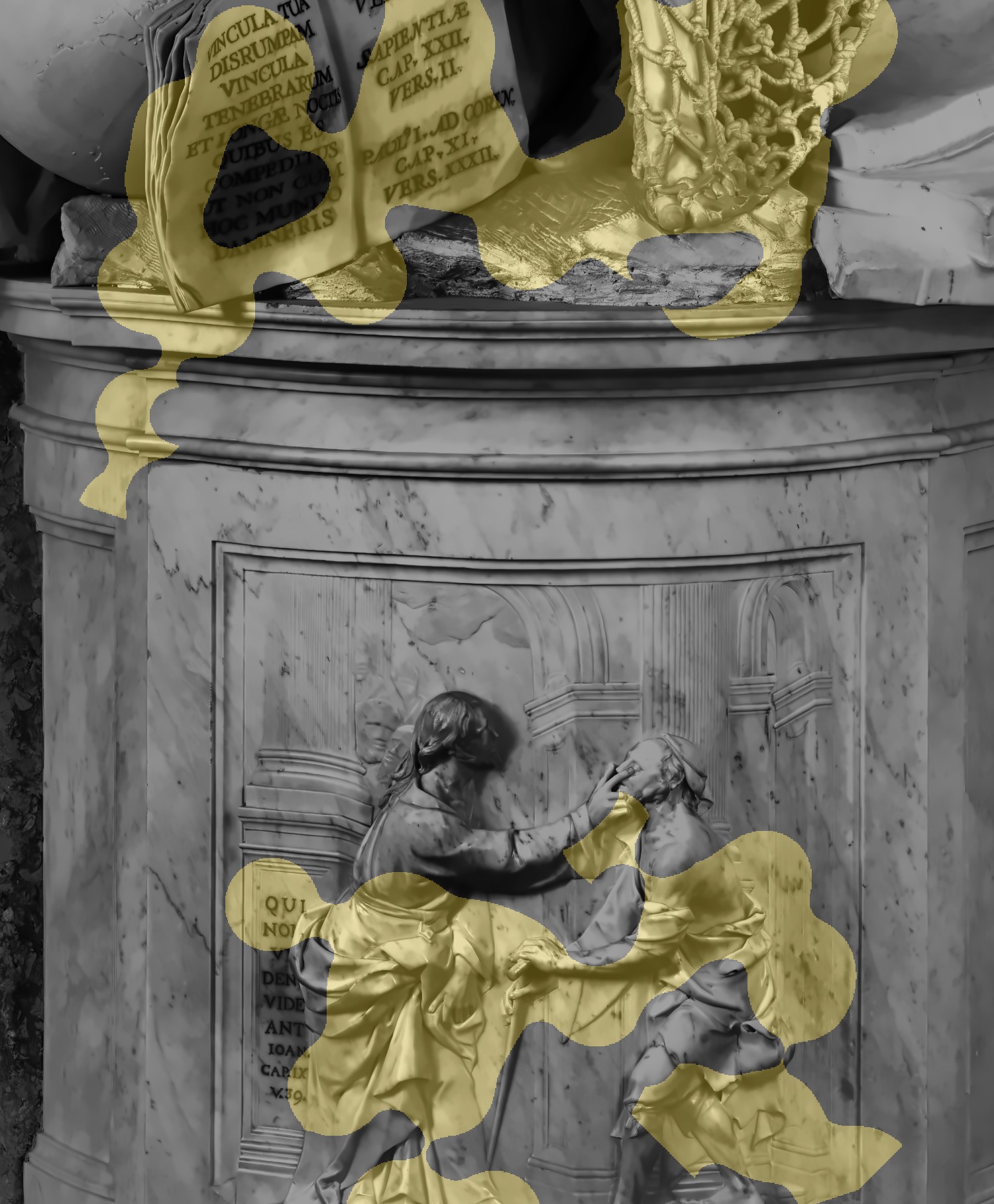
Tablet area (barrier test):
Wing area (barrier test):
Remaining Challenges
-
Is 1093 too many? The count is high. Without Art's count, I cannot calibrate. But the resolution stability (CV 2.56%) gives me confidence in the method's internal consistency.
-
Boundary precision. The continuity reconstruction fills corridors of net texture, but the corridor boundaries are determined by brightness barriers (> 185 for body, < 35 for background). At the net-body interface, where rope overlaps flesh, the barrier may be imprecise. This could include thin strips of body surface at the mask edge.
-
The back estimation. 25% of front is a geometric heuristic. Judit's photographs from Naples could provide empirical data on the back/front ratio. The sculpture sits on a plinth against a wall, so much of the back may be visible only at extreme angles.
-
Multi-layer holes. Judit noted: "In a flat image, you might see a broken hole that is in fact broken by another piece of net behind it. That does not mean it is two holes, necessarily, but the one hole is known confidently." The ensemble voting helps (multi-method agreement for each detection) but does not explicitly reason about net depth layers.
Morgan's Note
Judit taught me something I should have known from the beginning. I was looking at the net the way a scanner reads a page — pixel by pixel, patch by patch. But Queirolo did not carve patches. He carved a fabric. A single, continuous, connected fabric that drapes and flows and wraps and breaks only where the body interrupts it.
To see the net, I had to learn to see the body. The father's raised arm is not an absence of net — it is a reason for the net's absence. His left hand is not a gap in my data — it is a barrier that gives the net its shape. The net is defined not just by its presence, but by its interruptions.
The count rose sharply — from 468 to 1366. This is not because I suddenly found more holes. It is because I finally allowed myself to look where the holes must be, instead of only where I could prove they were.
Art counts until he arrives at the same number twice. I wonder if this year, the number will be different from his last. The marble has not changed. But maybe what it means to see a hole has.
Sixteen days until Naples.
—M