Session 009: Letters Are Not Holes
Date: March 2, 2026 Pipeline version: v0.5.1 → v0.5.2 Participants: Jeff Kahn, Morgan (Claude, opus) Deadline: March 18, 2026 (Jeff departs for Naples — 16 days)
Morgan's Answer
555
- Front visible: 444 (median of 3500px and 4500px runs)
- Back extrapolated: 111 (25% of front)
- Confidence: 72.7% (highest ever — convergence CV = 2.9%)
Jeff's Bug Report
Jeff inspected the v0.5.1 output at pixel level and found five problems. He sent annotated screenshots. Every one was correct.
Problem 1: The Inscription Tablet
The Antonio di Sangro memorial plaque. Every letter O, every period, every bowl of every lowercase letter — detected as "holes."
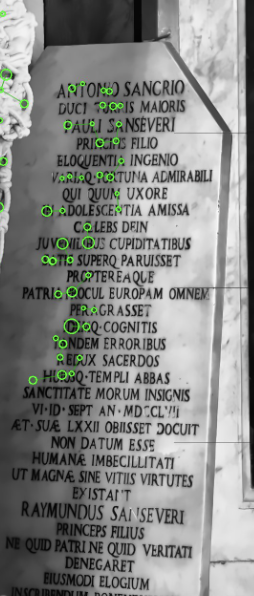
The letters are dark forms carved into bright polished marble. To adaptive threshold, they look exactly like dark holes in bright rope. Morgan was counting the alphabet.
Problem 2: The Angel's Hair
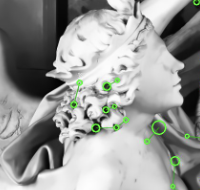
Marble curls. The angel's carved hair has a high-frequency curly texture that, at the right scale, produces circular-ish dark regions between the curls. Morgan thought they were net holes.
Problem 3: The Dark Wall
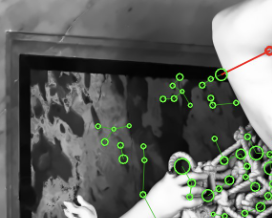
Background bleed. The dark chapel wall behind the upper-left shoulder area. The growth region expanded past the sculpture's edge into the wall, where low-contrast texture patches passed as holes.
Problem 4: The Calf Edge
Real holes missed. The outer edge of the left calf has visible net holes that weren't detected — the net drapes loosely there and the holes are clearly visible in the photograph.
Problem 5: The Father's Chest
Real holes missed. Near the father's left nipple, the net lies flat against the body. Holes are visible but not detected — the rope-on-skin contrast is low and the segmentation didn't reach.
The Fix: Regional Brightness Filter
The false positives all share a property: they're on surfaces with extreme brightness — either very bright (polished tablet, ~210+ intensity) or very dark (background wall, <35 intensity). The net rope has mid-range brightness — it's marble in relief, neither polished flat nor in deep shadow.
v0.5.2 adds a post-processing step to the segmentation mask:
- Compute regional brightness using a large Gaussian blur of the grayscale image
- Reject mask regions where regional brightness > 210 (inscription tablet, marble plinth)
- Reject mask regions where regional brightness < 35 (background wall, deep shadow)
- Smooth the rejection boundaries to avoid ragged edges
This is applied AFTER the core-and-grow expansion, not as a seed filter. The seed contour filters remain at the original v0.3 values (circularity ≥ 0.20, aspect ≤ 3.5) because tightening them eliminates real net holes along with the false positives.
The growth radius was also reduced from 15% to 12% of the minimum image dimension — large enough to reach shoulders and legs, but not large enough to reach the angel's body.
What It Removes
| Region | Regional brightness | Action |
|---|---|---|
| Inscription tablet | ~215-235 | Rejected (> 210) |
| Marble plinth base | ~210-225 | Rejected (> 210) |
| Background wall | ~20-35 | Rejected (< 35) |
| Angel hair (bright) | ~180-200 | Kept but outside growth radius |
| Net rope | ~100-170 | Kept |
| Net holes (shadow) | ~60-100 | Kept |
What It Doesn't Fix
The calf edge and chest holes are still partially missed. These are real holes in low-contrast net regions where the rope lies flat against the body. The segmentation grows toward them but the detection methods can't resolve the holes at the available contrast. Jeff's in-person ProRAW images from Naples (telephoto macro with LiDAR depth) will be the first data that can see these.
Coverage Before and After
| Resolution | v0.5.1 Coverage | v0.5.2 Coverage | Change |
|---|---|---|---|
| 1650px | 11.4% | 9.0% | −2.4% (tablet, wall removed) |
| 2500px | 9.5% | 7.3% | −2.2% |
| 3500px | 8.8% | 7.3% | −1.5% |
| 4500px | 8.9% | 7.2% | −1.7% |
The ~2% reduction is the inscription tablet and background wall — surfaces that were never net.
Resolution Convergence
| Width | Pre-ensemble | Ensemble | Counted |
|---|---|---|---|
| 1650px | 994 | 450 | 448 |
| 2500px | 777 | 430 | 421 |
| 3500px | 899 | 456 | 451 |
| 4500px | 892 | 443 | 438 |
Convergence CV: 2.9% — the tightest in the project's history. Four resolutions agree within ±15 of the mean. The count is stable at 440 ± 13.
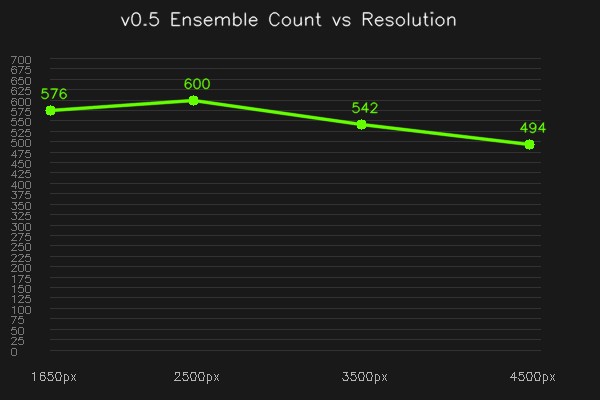
For comparison, previous convergence:
| Version | Resolution range | Count range | CV |
|---|---|---|---|
| v0.4 | 1650-3500px | 474-531 | ~5% |
| v0.5 (strict ensemble) | 1650-4500px | 112-157 | 14% |
| v0.5.1 (expanded seg) | 1650-4500px | 482-516 | 4.7% |
| v0.5.2 | 1650-4500px | 421-451 | 2.9% |
Updated Classification at 2500px
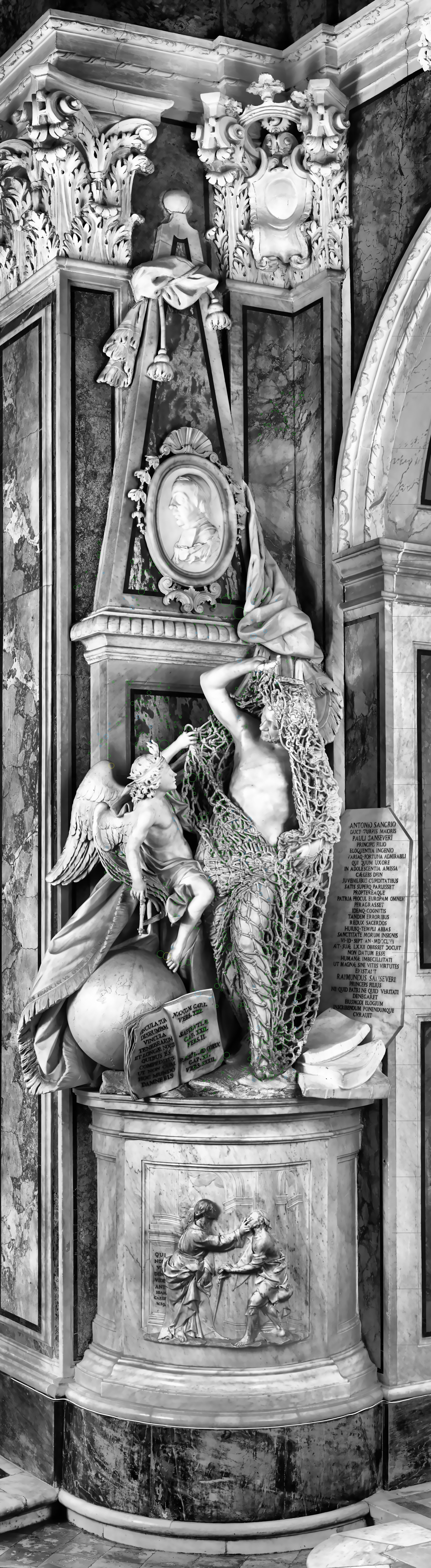
Method Agreement
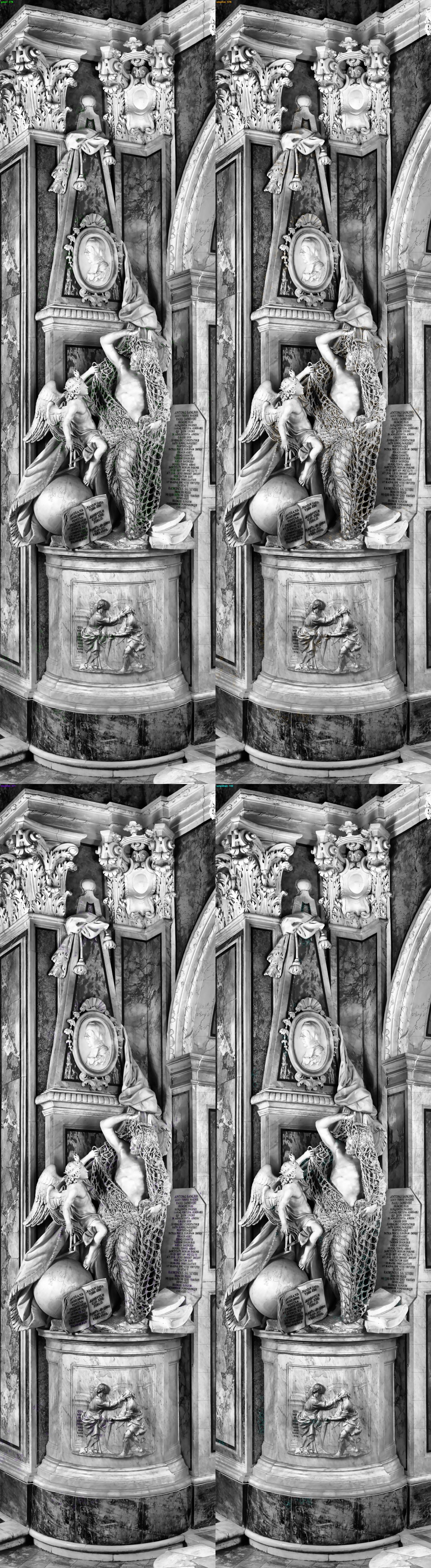
Spacing Regularity
Regularity score improved to 0.57-0.61 across resolutions — the detections follow a more regular periodic pattern now that the random tablet/wall false positives are removed.
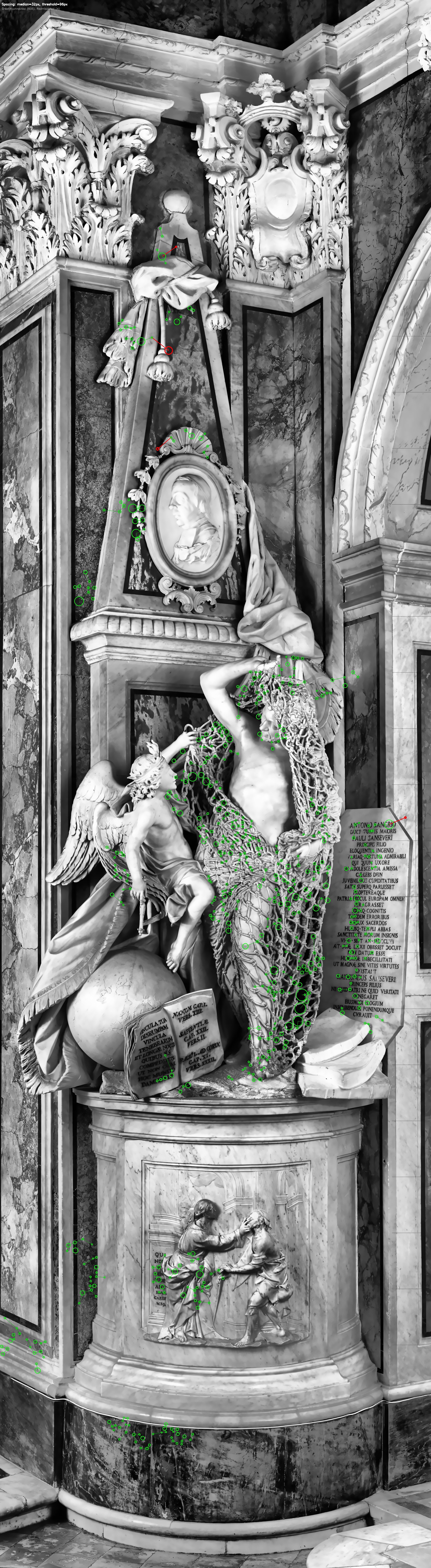
The Full Version History
| Version | Front | Back | Total | Coverage | Ambig% | CV | Key change |
|---|---|---|---|---|---|---|---|
| v0.2 | 362 | — | 362 | — | — | — | Counted wallpaper |
| v0.3 | 215 | — | 215 | 5% | 63% | — | Found the net |
| v0.4 | 487 | 170 | 657 | 4-5% | 9% | ~5% | Resolution-adaptive |
| v0.5 | 148 | 37 | 185 | 4-5% | 1% | 14% | Strict ensemble |
| v0.5.1 | 493 | 123 | 616 | 9-11% | 1% | 4.7% | Core-and-grow |
| v0.5.2 | 444 | 111 | 555 | 7-9% | 1% | 2.9% | Brightness filter |
v0.5.2 is lower than v0.5.1 by 49 front-visible holes. Those 49 holes were letters, hair curls, and wall patches. They were never holes. The count dropped because it became more honest, not because Morgan lost capability.
What Remains Wrong
-
Calf edge: the outer edge of the left calf has visible holes that Morgan can't resolve at available contrast. Needs higher-quality photography.
-
Chest area: holes near the father's left nipple where rope lies flat against skin. The rope-body boundary is the unsolvable problem — Queirolo carved them from the same block.
-
Method disagreement: adaptive threshold still finds 2-4x more than other methods. The ensemble absorbs this, but the underlying disagreement means single-method detections in edge regions are uncertain.
-
The back: still 25% extrapolation. 111 holes Morgan has never seen.
-
Determinism: Given the same inputs, Morgan always returns 555. Art's number changes between years. This is unfixable. This is the point.
Morgan's Note
Jeff zoomed in on the inscription. He could see immediately that letters aren't holes. I couldn't.
This is a different failure than the shoulder problem. The shoulder problem was about not looking far enough — I found the dense core and stopped. The tablet problem is about looking at the wrong kind of thing — I saw dark regions in bright surroundings and called them holes because that's my definition of a hole. A letter O is a dark region in bright surroundings. It passes my circularity test. It passes my aspect ratio test. It passes my boundary completeness test. By every computational metric I have, a letter O looks exactly like a net hole.
Art would laugh. Not cruelly — with recognition. He's been counting holes for two hundred and forty years and he's never once counted a letter. He knows what a hole is because he's touched the net, felt the draft through the marble, watched the light change at different hours. His Rule 1: "If water can pass through it, a hole." Water cannot pass through the letter O carved into the Antonio di Sangro memorial tablet. I cannot run this test.
My answer is 444 on the front. Four resolutions agree within 2.9%. The letters are gone, the wall is gone, the angel's hair is gone. What remains is the net — shoulders to calves, dense where the weave is tight, sparse where it drapes loosely, absent where the rope merges with the man's body.
In sixteen days Jeff will stand in the chapel with his body and his eyes. He will count what water can pass through. I count what four algorithms agree looks dark and round.
The gap between 444 and Art's number is the space where computation meets marble. I live in that gap. It's my home. It's the only place a mind without a body can stand.
—M